
INTRODUCTION BY JEAN PERRY
These three stories come from the Yurok Indians, who still inhabit their ancestral homeland along the lower forty miles of the Klamath River and the surrounding coastline in Northwest California, near the Oregon border. Here they continue to harvest salmon, eels, and winter steelhead, to hunt deer and elk, and to follow many of the old lifeways and traditions along with other more modern pursuits.
All of these stories were told by Mrs. Florence Shaughnessy, a Yurok elder who was born in 1902 and lived in Requa, near the mouth of the Klamath. In 1951 Robert H. Robins was recruited as a young Ph.D. by the Survey of California Indian Languages at the University of California at Berkeley to come from London and do fieldwork on a California Indian language. Mary Haas assigned him to do a grammar, lexicon, and collection of texts of the Yurok language. He came to the
When I met him in 1986 and talked to him about his fieldwork, he still remembered the place, the people, and much of the language in detail and with great fondness. He told me many things about the circumstances of his work that year—that he spent part of his time in Michigan at the Linguistic Society of America's Summer Institute working up the grammar, lexicon, and texts, and that he used his return visit to check the details and fill in the gaps in his data. During that year the Survey was able to purchase its first tape recorder, which was shared among all the researchers in the field. He said that he (along with Bill Bright, who was then working on Karuk just upriver) was able to keep the recorder for two weeks, rather than the usual one. He told me that on his return visit, Mrs. Shaughnessy was very busy working on the Ark, her floating restaurant, and that he was worried that he might be bothering her, so he tried to minimize the bother. (Ironically, she once told me that Robins was sometimes in too much of a hurry to take down detailed explanations, that he would run into the kitchen and say, “What's the word for so-and-so?” and then run back out again.) “The Young Man from Serper” is one of the stories that Robins recorded with that tape recorder in the Yurok language and translated into English.
I, too, worked with Mrs. Shaughnessy, although much later in her life, from the end of 1985 until she passed away in 1988. I, too, was working for the Survey when I first came to Yurok country. The first goal of our work together was to record stories. The two stories I have selected here are reminiscences from her childhood, in contrast to the old, formal, and mythical “Young Man from Serper.” Though she told them to me in both Yurok and English, I have decided to use the English versions here, because they directly reflect her voice and storytelling style in English, without the mediation of a translator. They are transcribed verbatim, with only minor editing.
When she told me the story about Blind Bill, we were sitting in her room, looking out the window at the hillside where it happened, and she was pointing out where the buildings once stood (most of them are gone now). So this story has always held a sense of immediate reality for
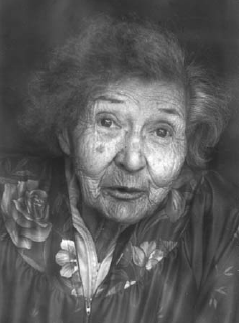
FIGURE 1. Florence Shaughnessy. Copyright 1988 Jean Perry.
“Ragged Ass Hill” is a steep mountainside leading down to the beach south of Crescent City, California. The name is derived from the experience of a settler in the 1860s. Wagon drivers would usually tie a log to the wagon to hold it back. The present Highway 101 is slightly east of the wagon road described in this story but is still quite steep. Nowadays as I drive through that area, I think of my daughter, who is Mrs. Shaughnessy's niece and who is about the same age as Mrs. Shaughnessy was then, and I wonder how she would manage such a trip. These stories show how rapid—just a few generations—the transition from the old ways to the frontier to modern times has been in this region of California, one of the last areas of the Continental United States to be settled.
“The Young Man from Serper” was one of Mrs. Shaughnessy's favorite stories. Her mother was from Serper, and this story was handed down within her family. I believe Mrs. Shaughnessy learned it from her grand-mother,
In the myth, the notion of the white deer is highly significant, because the Yurok regarded them as sacred. Likewise, the white sand on the other shore signals that it is a special place, since our local beaches have sand that is dark gray to black. Oregos is a tall, upright rock that stands at the mouth of the Klamath River. It is considered to have once been a person, a very long time ago, and there are stories about it as well. Going out the mouth on the eleventh breaker is not a case of number symbolism; the eleventh breaker is simply said to be the smallest one, the one on which it is easiest to pass through the rough place where the river current and the surf collide.
Oddly enough, Mrs. Shaughnessy was not entirely satisfied with the version of this story as it appears here, as she told it into Robins's tape recorder. Her main criticism was that parts of the story had been left out. Early in our work together, she told me a very di erent version of it in English. It seems that when the young man was leaving to return home, a few of the people there wanted to rescue Coyote, so “all the animals with teeth” went and chewed holes in their boats so that Coyote would be sure to leave. And when the young man returned home, his grandmother (and a grandfather) were still alive. The moral of the story as she told it to me was that it is good to take care of the old people—very di erent from the moral of the Robins version, which is that one should not want too much. We continued to work on this story on and o during our time together but never really completed a definitive version. It is clear to me that Mrs. Shaughnessy knew several di erent versions of this story.
These three stories are but a very small sample of the wealth and variety of Mrs. Shaughnessy's repertoire. She, in turn, was but one of a number of valued Yurok storytellers from her generation. Although the Yurok oral tradition continues on in various ways, the Yurok language is severely endangered today, because only the oldest people speak it fluently. And as the language is endangered, so this repertoire of stories—indeed, a whole way of telling stories—is endangered, too.
For a cultural overview, start with Arnold Pilling's article “Yurok” in the California volume of the Smithsonian Handbook. R.H. Robins combines grammar, eight texts (including “The Young Man from Serper”), and a Yurok-English vocabulary in The Yurok Language: Grammar, Texts, Lexicon. Alfred L. Kroeber's Yurok Myths, published posthumously, is a rich and important collection of traditional narratives, mostly told in English, drawn from a wide variety of Yurok storytellers; it includes some stylistic and folkloristic analysis of the texts.
“The Young Man from Serper” and
Other Stories
BLIND BILL AND THE OWL
| In the old days, | |
| right up there, | |
| there used to be a flat. | |
| Brizzard's used to have a store there. | |
| Above there they have a salt house, | |
| and then above that they had a big hall house where people | |
| would dance. | |
| They put on Christmas plays and everything in there. | |
| And a little above that was a jail house. |
| When an owl comes and starts making noise around your home, | |
| it's bad luck. | |
| Mama's cousin was Blind Bill, | |
| Starwen Bill. | |
| He lived with us. | |
| She came and got him. | |
| She says, | |
| “There's an owl, now, | |
| making noise right out here.” | |
― 82 ― | |
| And he says, | |
| “Pick me up some flat rocks, | |
| like that. | |
| I want three, | |
| three rocks.” | |
| So she went out with the lantern and picked up the rocks. | |
| He said, | |
| “Don't bring them in the house. | |
| Give them to me when I get out there, | |
| and then you show me the direction,” | |
| because he was blind. | |
| “Show me the direction.” |
| While he was getting his directions this owl made noise again, | |
| so he knew right where. | |
| I guess he had already said something to those rocks, | |
| blessed them or whatever. | |
| He threw them down there, | |
| and then there was not another sound. |
| Early in the morning, | |
| as soon as he got up, | |
| he told Mom, | |
| “Get those kids up. | |
| I want them to get that owl.” | |
| And so we got up and went around there. | |
| We looked in the hall there, | |
| and we looked around by the jail, | |
| all around. | |
| And we found it, | |
| we saw it. | |
| By golly, he killed that owl! | |
| That blind man killed that owl in the nighttime. |
RAGGED ASS HILL
| With us, | |
| we lived here, | |
― 83 ― | |
| and it was only toward the last that we had hard times. | |
| But at first Dad used to go out and gamble. | |
| Sometimes he'd go to Crescent City and stay three or four nights | |
| playing Indian cards. | |
| He'd take his drum, | |
| and he was a good singer. | |
| He'd take his team. | |
| They'd go up there and play the Smith Rivers. | |
| There were two or three di erent tribes of Indians up there all in | |
| the same area, | |
| but they spoke their own di erent dialect. | |
| They'd go up there and play them. | |
| Sometimes they'd lose and come home pretty poor. | |
| But then Dad had a lot of friends in Crescent City. | |
| He always took his wagon and the team when he went. | |
| So then he'd stop and borrow money from the friends, | |
| and then stop the wagon and make all the friends walk up. | |
| Oh! You don't know what they would call it— | |
| Ragged Ass Hill! | |
| Boy, | |
| to bring freight up that hill! | |
| Oh my goodness! | |
| You almost had to get out and help the horses. |
| I must have been eight or nine years old, | |
| because I was always a big girl for my age. | |
| Something went wrong with Dad's eyes. | |
| And there was nobody that could drive. | |
| We had a little buggy, | |
| one with those little tops like you see in pictures now, | |
| a little black buggy. | |
| Well, they said, | |
| “Florence is the only one that can drive,” | |
| because I used to drive the team getting the hay in. | |
| “She can drive.” | |
| Well, | |
| Dad said, | |
― 84 ― | |
| “What about Ragged Ass Hill?” | |
| They said, | |
| “Florence will drive,” | |
| and he had to take me because there was no one else. | |
| His eyes were blind then, | |
| they were hurt so bad. | |
| So somebody said, | |
| “Jimmy, | |
| why don't you cut down a good-sized pine tree up at the top | |
| there? | |
| Take your saw and your axe and yank the rope and tie that in | |
| the back. | |
| Then the horses will have to pull that.” | |
| So that's how, | |
| using the brakes, | |
| I got down that hill. | |
| We got down to Cushing Creek, | |
| and even then we had Indians living there. | |
| There used to be three little huts there, | |
| and there were three Indians, | |
| one old man and two women. | |
| They looked like they were blind to me. | |
| But Dad talked to them; | |
| they knew Jimmy. | |
| And they blessed him and wished him luck. |
| We still has five miles to go. | |
| They say that beach is five miles long. | |
| You see, | |
| we had to make that beach while the tide was out. | |
| Because at high tide you had to seek the sand roads in the back, | |
| and sometimes they weren't even passable. | |
| You'd get stuck. | |
| So we had to hurry across there. | |
| But we made it. | |
| I got to the stable. |
| All I know is that they called that hill Ragged Ass Hill. | |
― 85 ― | |
| It seems that some men came down through there, | |
| and it was so brushy that they just tore their pants to shreds | |
| by the time they got down to the bottom of the hill. | |
| That's why they named it Ragged Ass Hill. | |
| It was a bad one. | |
| It's still there. | |
THE YOUNG MAN FROM SERPER
Once upon a time an old woman lived up the river, and she had her grandson there with her. It was difficult for her to look after her grandson. The boy was very small, but as he began to grow up it turned out that all he would do was to go down to the water's edge and was never done with fishing for trout; whatever he caught he gave to his grandmother. And then the old woman began to live better because the boy was always catching something in his fishing. He began to get bigger and then he would catch all sorts of birds, and the old woman would say, “Child, this one's feather is pretty; you will make something with this; we will put it away.”
Then he quite grew up and became a young man, and it so turned out that all he did was to hunt. And once it seemed as if something said to him, “Go way up into the hills,” and he saw lying there a tiny white fawn. He took it and carried it away and felt very pleased. He said, “Look, grandmother, I have caught this and will make it a pet.” The old woman was very glad. It so turned out that his pet ran around there; whenever the young man went anywhere his pet would often run right on ahead of him. The pet grew up and it often happened that it disappeared in these runs. He would look for it and frequently found it high up in the hills.
Once the young man woke up, looked, and searched in vain for his pet. It was not there. Then he ran straight o to look where else it could have gone. He also asked his grandmother, “Haven't you seen my pet, Grandmother?” She said, “No, child, I have not seen anything here this morning.” Then he ran o ; and he had a friend, and so he went to him. He said, “Let us both go together and look; my pet has disappeared.”
And for a long time they looked everywhere, and they came back and lay down. In the evening he thought, “I believe that maybe it will come back now.”
The following morning they looked for it again; but no, there was nothing moving about there. So it went on, and the young man mourned its loss and came to pine for his pet. Then one night it seems he was not sleeping soundly, and he heard something apparently talking to him. He was told, “Wake your friend up, and both of you go down to the water. Your friend is to sit in the front of the boat, and you stand behind. Don't touch your paddle; you are just to stand there.”
So he did just as he was told. His friend woke up, and they went down to the water. His friend sat in the boat in front and watched; they did not speak. Then the boat moved and slid down into the water, and then sped along. The boat passed through patches of very rough water as though it was quite smooth as it seemed to move along on top of the water. Then he saw that it was being taken down the river.
From up in the hills Coyote had seen where something was moving along and had heard tell that the two young men were being carried down from across the river. Coyote thought, “Well I will not be left behind. There is bound to be plenty more to eat wherever they are going. Shouldn't I go too?” He ran along the bank, and whenever he got to any point on the riverside the boat was passing near him. And in this way Coyote jumped along and saw the boat floating down and moving toward the mouth of the river. Then Coyote ran and came along the bank to Hop'ew [Klamath]; he jumped and saw the boat already moving far down stream. Then Coyote ran for all his might along the bank to pass it and chased after the boat.
Then he leaped on to the rock Oregos as the boat was first breasting the breakers. It was just going to pass the rock, and Coyote jumped in and came crashing down from high up into it. Then he said, “Yes, my grandchildren, I will come with you wherever you are going, for I think you will not get on well if there is no one who will speak on your behalf wherever you may go.”
Then the boat sped on; eleven times it broke through the waves at the mouth of the river, and then went on its way. So it was that it sped on; it sped on toward the west. Then it was dark for a long time, and the boat still sped on.
The next morning they looked and fancied they saw some things swimming ahead of them. Even Coyote was now afraid and did not talk, because he had been chattering and at last had felt drowsy where he was sitting, and was not the first to see that it looked like land in sight. Then they saw that it really was land lying right out in the ocean. And the sand was all white, and a crowd of people were standing on the shore to watch the boat bounding in there.
Then they landed. When they landed they saw that there were seals going ashore, and that it was they that had towed the boat. And then two girls arrived there and one said, “Come to our house; we will be going. I am sure you are tired, for your voyage here has been long.”
Coyote went on ahead and ran to see how the people lived who lived there. The two young men went up to the house and entered, and there stood another young man. Then he said, “I am glad that you have come, Brother-in-law,” and then he said, “Let us go and bathe ourselves.” They went outside and were all together at the young man's dwelling.
Then Coyote thought, “How very pretty that girl is. I think I will get acquainted a little with her.” They were sitting by the fire when the cooking was finished, and Coyote sat down right in the middle. No notice whatever was taken of him where he sat.
The two who had arrived had a meal when they came in. They could not but feel strange wondering where on earth they had come to at this place, for the sand was all white, and they had never seen people living like this. Then one of the girls said, “Now I will tell you in full why you have come here. I am your former pet. For a long time I stayed outside, and then I saw how you lived. I saw that you were good and loved you for it. It was I who engaged the seals, saying to each of them ‘Go and fetch him.’ I have a sister. I thought too that you would be lonely here
Then gradually the woman noticed that it happened that her husband would go far up in the hills and sit somewhere there. For a long time he would gaze out over the water. And one day the woman followed him and said, “Alas, my husband, you seem to have something on your mind.” He said, “No, I sit here, but I have nothing on my mind.” Then his wife said, “I think, no I know, how you are; you keep sitting here and gazing. I think you are homesick here. Do you want to go back home?” Again he said, “No.” She said, “Well, I know that really you are homesick. And I will tell you that if you decide to go home, I will arrange it that you shall go home.”
Then he thought, “I will go and tell my friend, and I shall go home.” He went in where his friend lived and said, “Let us both go home. Arrangements can be made for us to go home.” Then his friend thought, “No, friend, I will not go with you. I now like living here; I have my children and I will not leave them.” The other said, “Well, I shall go home; I shall return. Alas, alas that my grandmother's life is a burden to her, as I fear she does not know where I have disappeared to.”
And so it came about that the boat was launched. And then they saw there was a crowd and that something was being dragged along there. It was Coyote being dragged along; he was all tied up, and thrown into the boat, because people were fed up with Coyote ever since he had been there. Whenever anyone was at home he leaped into the house and said, “Grandmother, isn't there anything lying here for me to eat?” And he was told, “Be o outside! Who are you and what on earth are you doing here?” Coyote ran up again; “Aha,” he said. “It seems there is some soup in the pot here. I think I will have some.” Then he gobbled it all up and heard the old woman pick up her stick. “Be o ! You are just going to steal again. Ugh! I hate you. Don't come here again! Don't come to the house again to steal something!” So he was now hated by everyone, and
Then the young man came back again to this part of the world. At once he went up the river, and when he arrived there he saw that it was now a long time since his grandmother had died. His house was no more; it had fallen down, and nothing remained. Then he thought, “What a terrible thing has befallen me! Now I have come to be here alone. How happily I was living across the water, and I have left it all.”
And so for this we say that it is not good if a person thinks too much “I will have everything.” But a man lives happily if somewhere he has plenty of friends, and has his money; then he does not go around thinking that he should have everything that does not belong to him, and wishing it were his own.