
Six
Quotas, 1935-1941
Mr. Manuel L. Quezon, acknowledged leader of the Filipino bourgeoisie, is again arriving home from one of his innumerable missions to the U.S. The political machine which [he] has built thru years of intrigue, misrepresentation, personal aggrandisement and enrichment is given a holiday to greet him. The leaders of finance and industry in whose hands he has been a willing tool, will be at the pier to pat his back. Thruout all the ballyho of "Mabuhay" and "Hurrah" he will remain a calm and engaging person with a holy feeling of having accomplished something for his country.
But which is HIS country? Is it Spain, the land of the Elizaldes, Sorianos, Ossorios . . .
Perhaps his country is the land of the Yulos and Alunans—the errand boys of the sugar interests.
Philippine Communist Party Handout (1935)
Following upon the first, harsh imposition of quotas in 1935 down to the invasion of the Philippines by Japan at the end of 1941, members of the Philippine sugar industry adjusted to a stagnant market. The quota system neither eliminated surpluses nor wholly protected prices; still, it probably staved off the demise of the export sugar industry. Filipinos sold their product above world prices and briefly experienced some prosperity. By 1941 sugarmen had learned to live with imposed restrictions and had adjusted their thinking, industrial structure, and activities to those limitations.
Quotas stunted production, and hacenderos found themselves more heavily regulated than ever before and having to depend more upon industry leaders to look after their interests vis-à-vis government. Profits became more inequitably distributed in favor of the upper crust of society, even as the pie ceased to enlarge; thus, limitations exacerbated tensions among the industry's participants, and the struggles grew in frequency and intensity. If sugar society achieved its modern shape during the era of centrals, that form solidified during the subsequent period of quotas. The Philippine sugar industry thus reached its maturity, no longer growing but
Table 15. | |||
Year | Export | Quota under | Value of All Exports (%) |
1934 | 1,152,841 | 920,971 | 59 |
1935 | 516,233 | 833,123 | 35 |
1936 | 899,838 | 968,935 | 45 |
1937 | 871,045 | 984,581 | 38 |
1938 | 868,253 | 959,281 | 43 |
1939 | 874,728 | 955,143 | 32 |
1940 | 976,474 | 1,004,477 | 31 |
1941 | 775,651 | 996,161 | n.a. |
Sources: Roy A. Ballinger, A History of Sugar Marketing, Economic Research Service, Agricultural Economic Report, no. 197 (Washington, D.C.: U.S. Department of Agriculture, 1971), p. 40; Carlos Quirino, History of the Philippine Sugar Industry (Manila: Kalayaan, 1974), p. 58; Sugar News 16 (1935): 99, 456; 18 (1937): 433; 19 (1938): 45; 20 (1939): 404; Tribune (Manila), August 11, 1936, p. 2; December 8, 1938, p. 2; June 18, 1941, p. 12; Robert Huke, Shadows on the Land: An Economic Geography of the Philippines (Manila: Bookmark,1963), p. 316. | |||
Note: Because of existing laws and agreements, between 99 and 100 percent of all Philippine export sugar went to the U.S. market during these years. | |||
rather facing a period of consolidation and declining vitality. Events of World War II and the postwar years scarcely altered before the mid-1970s patterns formed during the pre-1942 commonwealth period.
Sugar under Quotas
The age of quotas began in crisis. The Jones-Costigan Act decreed a retroactive limit on duty-free sugar shipped to the United States of just 920,971 tons for 1934, some 231,870 tons less than the amount actually sold; moreover, the Philippines still had 1934 sugar held in customs bond that could not enter the American market before January 1, 1935. Hence, Philippine sugarmen faced an effective 1935 quota of some 520,000 tons for sugar exported in that calendar year, less than half the total sent the preceding year (see table 15).
Whereas total centrifugal sugar production for the 1933-34 season reached a record 1,431,920 metric tons, that for the 1934-35 season came in at just 631,142 tons. Beginning as early as May 1934, Negrense hacenderos, in anticipation of the impending curtailment and because of a temporary credit squeeze, began laying off workers, and employment remained depressed until late in 1935. In early January 1935 sugar piled up in overcrowded warehouses while nervous millers and farmers awaited
the government program to determine their individual quotas for the year. To lower their harvests, many planters destroyed standing cane; some diversified, raising livestock and other crops on a limited scale to support themselves. Anxiety rose highest among marginal producers, who feared that even a modest loss of output would move them below the survival level. The drop in production for 1935 represented a major blow to the well-being of workers and small farmers without an economic cushion. The consequences of crop reductions spilled over into related industries; thus, the government-owned Manila Railroad faced sharp revenue losses because of decreased sugar movement from central Luzon, and provincial and insular governments laid off employees in the face of declining tax revenues.[1]
Expressions of gloom haunted the local press as sugarmen anticipated the closing of the duty-free American market. Comparisons of the cost of producing and shipping Philippine, versus Cuban, sugar to U.S. refineries revealed that the former had almost no chance of ever competing on an even basis with its Caribbean rival. Furthermore, the state of the world sugar economy, of oversupply and underdemand, dictated long-term Filipino dependence on North American sales. This judgment seemed confirmed when attempts to improve local purchases of centrifugal and refined sugar came to naught. Instead, sugarmen found that avenue dosed because shoppers continued to prefer cheaper muscovado sugars; what increase in consumption occurred, came about because planters sold cane not allowed to go to centrals to insular millers of crude sugar.
Bad news afflicted markets sporadically in the first half of 1935. Inauguration of the new quota system caused some temporary dislocations, and brief shortages in the availability of domestic Philippine sugar supplies created an anomalous situation whereby in the early months of that year local retail sugar sold at higher prices than the export product. In midyear rumors that the U.S. Supreme Court might strike down quota provisions of the Agricultural Adjustment Act caused the price of Philippine sugar to plummet (see figure 5). Enactment of Jones-Costigan had sent sugar prices back up to 1930 levels, but fears of its elimination caused momentary panic. Producers and buyers of insular sugar feared that in the event of such a judicial decision, Cuba would be allowed to flood the American market with its less expensive product, while the Philippines would still be bound by the duty-free limitations of the Tydings-McDuffie Act. Only when it appeared that the law would stand did sugar prices climb again.[2]
Not all initial consequences of the Jones-Costigan and Tydings-McDuffie acts proved harmful to the Philippine sugar industry. Assignment of quotas all the way down to the level of the individual farmer had proceeded effi-
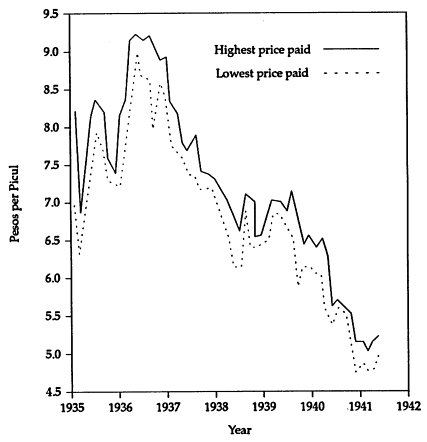
Figure 5.
Sugar Prices on the Manila Market, 1935-41. Sugar News 16-22
(1935-41).
ciently and, by most accounts, equitably. Governor-general Frank Murphy, in charge of allocation of quotas, turned this complex project over to his assistant, E. D. Hester, and to the collector of insular customs, J. Weldon Jones, and they managed to keep the distribution free from political influence. By October 1935 each planter and miller had a firm allocation for the amount of sugar he or she could produce. A further advantage of market stabilization under the quota system flowed to planters when the New York Coffee and Sugar Exchange voted to allow trading in Philippine sugar futures, beginning in 1935. Planters and merchants could now sell their crop earlier, at times when they could realize a higher price for it. The government began releasing small quantities of domestic consumption ("B") and export ("A") sugar from warehouses as early as January 1935, and in March
Secretary of Agriculture Henry Wallace allowed mills to grind cane for the manufacture of twenty million gallons of alcohol for local and U.S. sale.[3]
A proviso of the Jones-Costigan Act allowed compensation to planters for cane burned during 1934-35. The payback money came from a processing tax on finished sugar (one-half cent per pound) imposed on U.S. refiners. Between January 1935 and July 1936 more than 17,000 Philippine planters received some $14,000,000 in payments at P2.40 per picul. To celebrate, Bacolod hacenderos held a "processing tax ball" accompanied by the usual beauty contests. These benefit payments to farmers, a typical New Deal program, ceased in the Philippines with the establishment of the commonwealth. Later in the 1930s the U.S. government revived the practice of returning sugar tax funds to the Philippines, but because of court decisions the money went to the commonwealth government for broader agricultural planning.
While the initial benefits program aided suffering farmers, distribution of funds did not proceed without problems, especially for tenant producers. Money went to planters and landowners of record at centrals; however, the law stated that all who actually grew cane on a reduced scale should receive a proportionate share of the payments. But casamac and inquilinos, primarily those from central Luzon who lacked documentary evidence of their production, had to depend on the largesse and goodwill of their richer partners to receive shares of the benefit payment, and some cheating took place.[4]
Economic distress associated with the 1935 constraints dissipated gradually during that year. Despite reduced operating hours, centrals still in debt to PNB yet managed small payments on their notes beginning as early as March. By December all mills resumed regular production schedules that continued into 1936, when market conditions improved to the point that even the Japanese purchased small quantities of Philippine sugar. Aside from 1935, sugar exports remained abe the levels of the 1920s, and initially at least, prices rose, from a prequota low of P4.50 to P9.10 per picul in mid-1936. Most mills earned considerable profits, and by 1937 all the bank centrals save Binalbagan had redeemed their mortgages. The managers at both the San Carlos and Silay-Hawaiian centrals issued exuberant reports for 1936, and the general prosperity in sugarlandia led to an increase of P6,000,000 net profit over the preceding year for PNB. Subsequent seasons did not witness the same prosperity, but centrals still managed to pay dividends to investors until at least 1940. Philippine coconut oil and hemp quotas under Tydings-McDuffie subsequently underwent revision, but the sugar quota held firm.[5]
American officials decreed that both the Tydings-McDuffie and Jones-Costigan trade provisions, and those of the latter's successor, the Sugar Act
of 1937, would continue to apply simultaneously. The Philippines was entitled to a quota of between 900,000 and 1,000,000 long tons based on its allotted share of U.S. annual consumption, but the independence act stipulated that only 800,000 long tons (812,846 metric) of raw "A" sugar and 50,000 (50,802 metric) tons of refined "AA" sugar could enter duty free. In practice insular sugarmen usually abided by the lower nondutiable figure, since with the tax added, they could not compete in terms of price with other suppliers (see table 15); thus, each year save 1940 they allowed their untilled quota under U.S. tariff law to be divided among other offshore producers. The commonwealth government also set annual quotas for raw sugar for domestic consumption that varied between 70,000 and 150,000 short tons and a reserve supply ("C") of raw sugar of between 30,000 and 100,000 short tons to fill any shortfall in the export quota.[6]
Further legislation regarding sugar exports reaffirmed regulations already in place. In response to pressure from American refiners, the U.S. Congress refused to allow the Philippines to raise its quota of refined sugar or even to export a washed, purer grade of raw sugar called turbinado. In early 1937 Quezon and Roosevelt, in accordance with section thirteen of the Tydings-McDuffie Act, convened a conference of commonwealth and U.S. government representatives to adjust economic arrangements between the two states prior to and following Philippine independence in 1946. The Joint Preparatory Committee on Philippine Affairs recommended only minor alterations in sugar matters: for example, it urged postponement of the imposition of the first export tax (5 percent of the total U.S. duty) from November 15, 1940, to January 1, 1941. The Tydings-Kocialkowski Act of 1939 legalized that change. During April 1937, emissaries of the commonwealth participated with the American delegation in the London International Sugar Conference, called to regulate global production. As a signatory to the May 6 agreement, the Philippine government pledged not to export sugar, including muscovado, anywhere but to the United States so long as the Tydings-McDuffie quota lasted. The international agreement, designed to apply initially for five years, merely confirmed Philippine dependence upon the American market[7]
While exports held constant, from 1936 on sugar prices followed a persistently downward course, hitting a low of P4.6 in April and May 1941. The market became so unfavorable that Spreckels and Company, formed in 1933 to purchase and export Philippine raw, ceased operations in late 1938, preferring to supply its parent U.S. West Coast refineries with greater quantities of Cuban sugar. The London agreement failed to reduce supplies sufficiently to reverse the slide, and prices dropped sharply during 1937 and the first half of 1938. Moreover, while other London signatories used the commencement of hostilities as an excuse to suspend their own
quotas, the restriction on the Philippines to ship exclusively to the U.S. market remained in effect. Even on the eve of Pearl Harbor in 1941, when shippers appeared in Manila ready to purchase sugar for delivery to Russia via Vladivostok, the Philippines could not gain a release to fill those orders.[8]
The onset of world war did not push prices upward. In the East, Sino-Japanese conflict in Manchuria and northern China left India and Java without an important market for their product. When Hitler's armies crossed into Poland in September 1939, sugar futures in New York surged briefly, and Roosevelt suspended quotas; however, since various countries had stocked up in advance in anticipation of the war, local shortages failed to occur, and he reimposed quotas in December. In 1940 a combination of factors, including the expectation of higher prices and a rush to beat the first Tydings-McDuffie duty of 26 centavos per picul in January 1941, led Filipino producers to rush large quantities to market; however, the higher prices never materialized. By early 1941 sugar prices had sunk so low that exporters proved reluctant to ship, since they were not even earning the cost of production. When global stocks finally began to diminish and prices started to rise in late 1941, warfare made commercial vessels more ex-pensive and scarce. The war-induced shortage of shipping only worsened conditions. Fifty kilos of ammonium sulfate, the preferred fertilizer, went from P7.50 to P9.00 between 1940 and 1941, while the price of a ten-pound bag of domestic granulated sugar fell from P6.15 to P5.80. George Fairchild devoted considerable effort that year in New York and Manila attempting to find transports; nevertheless, by early December the Philippines had not sent all its 1941 quota, and the invading Japanese found local warehouses stuffed with export sugar for 1942.[9]
Confronted by continuing world overproduction, rising freight rates, and the prospect of accelerating duties that would eventually make their sugar uncompetitive even in the U.S. market, Philippine sugarmen considered several remedies for their economic plight: lowering their production costs, limiting the number of producers, and diversifying their economic activities. Members of PSA suggested postponing the date of independence in order to maintain the privileged access for Philippine sugar. Others even spoke of nationalizing the industry in the event of dire emergency, but the first three plans, which all stressed cutting back on output and costs, received the most attention. And when planters and millers contemplated reducing expenses, they did not figure to do it by improving productivity—in those years sugar research by the industry largely ceased rather, they thought to do so by cutting jobs and wages.[10]
While quotas became a fact of life, Manuel Quezon increased his control over the sugar industry and commenced charting its future. Recent scholarship has demonstrated how he gained near dictatorial power over the
domestic political process at the insular, provincial, and local levels. He had rewarded some of his supporters by obtaining favors for them within the sugar industry, and as president of the commonwealth he sought to play an enhanced role in shaping the country's most economically vital activity. In a systematic way he strove to govern the sugar industry so as to encourage consolidation, to make it less politically influential, and to initiate internal changes that would weaken the potential for radicalism among poor sugar hands. Quezon had relied on sugar support in achieving victory over rivals Sergio Osmeña and Manuel Roxas during the political struggles over independence; now he employed sugarmen to act as his lieutenants in handling the industry.[11] To exert domination over sugar, lest its leaders oppose any of his plans or ambitions, he used a variety of mechanisms: supervision of the quota system, influence over PNB credit policy, and control over negotiations with the Americans on tariff relief and related matters.
The Philippine Sugar Administration, formed in late 1937, served as a major vehicle of Quezonian authority. Over its extensive staff he appointed two of his favorite henchmen, first Rafael Alunan and then in late 1938 Gil Montilla. Both had long careers in Negros politics, and the latter had served as speaker of the National Assembly when Quezon had needed a pliant friend in that position. As sugar administrators with cabinet rank they presided over an agency that not only set yearly domestic and reserve quotas, but settled numerous policy matters as well, including standardization of the size of sugar bags and regulation of muscovado sugar output that competed with centrifugal in the domestic market. Even more important, the administrator began to intervene in cases involving the reallocation of export quotas to planters and millers in the event of changes in land ownership and milling contracts. This latter authority, infrequently exercised before the Japanese occupation, offered the government great potential power over the lives and fortunes of many in the industry. With the first of the major milling contracts, at San Carlos, coming up for renegotiation in 1942, Quezon made it clear that the administration in-tended to play a part in redistributing industry profits more equitably. The Philippine Sugar Administration did not achieve absolute control over the industry; for example, it proved ineffective in preventing the dumping of sugar on the local market; nevertheless, sugarmen increasingly turned to this agency and to Quezon for decisions on policy matters.[12]
As senate president Quezon had in the 1920s and early 1930s exerted sway over PNB loan policy and had thus affected economic life in sugarlandia. In the later 1930s that influence only grew. Governor-general Frank Murphy in 1934 appointed a Quezon man, sugar corporation lawyer Jose Yulo, chairman of the board of directors of the bank, and Yulo stayed in
that position until 1938 while simultaneously serving as the common-wealth's secretary of justice. Meanwhile, PNB greatly strengthened its financial position with record profits from sugar and with the recovery of its loans to the bank centrals. Quezon thus held direct access to the PNB's decision-making body, and he used his leverage and the bank's enlarged assets to control and protect the sugar industry. To provide relief for struggling hacenderos the bank gave mortgages on reserve sugar, supplied money at reduced interest rates, and even provided cash to tenants who could offer only their crops as security. At the same time, the bank sought to discourage planters from using their crop loans to invest in mining stocks and other outside ventures, as they apparently did in large numbers in 1937. The net effect of this overall policy was to keep many farmers in business despite slumping prices and to assure their political docility and allegiance to Manuel Luis Quezon.[13]
While Tydings-McDuffie and the Sugar Acts of 1934 and 1937 set the main parameters for political and economic relations between the commonwealth and the United States, protecting Philippine sugar interests still demanded considerable attention, and here again Quezon took command. Sundry problems required ongoing settlement, and he carried out the negotiations through such surrogates as Resident Commissioner Joaquin Miguel (Mike) Elizalde and Felipe Buencamino. Both sugarmen attended the London Conference, and the former, along with Jose Yulo, defended Philippine positions during deliberations of the Joint Preparatory Committee on Philippine Affairs. Over the course of seven years the common-wealth fought over recovery of the excise tax on sugar stipulated in the Sugar Act of 1937, postponement of imposition of the Tydings-McDuffie export tax, relief for the sugar industry because of the damage done by the shortage of wartime shipping, prohibition of the U.S. Army in the Philippines from buying cheaper Javanese sugar, and clarification of the definition of refined sugar under the quota system. The commonwealth did not always have its way in these matters; however, in directing the negotiations, Quezon clearly established himself as chief spokesman for, and defender of, the sugar industry. Before 1935 the PSA had served as the sugar industry's main voice in Washington; its role now diminished. Harry Hawes continued as the organization's lobbyist until the war, but the PSA overseas office shrank in both size and activity. Elizalde became the most important figure at the U.S. capital on behalf of Philippine sugar, for he defended the industry as a whole rather than, as did the PSA, chiefly the millers.[14]
The commonwealth government also strove to consolidate its sugar holdings at home. It purchased the Insular and Malabon Sugar Refineries and so gained control of about 85 percent of the country's refining capacity.
In addition, despite efforts by individual investors to buy the Binalbagan Central from PNB, Quezon elected to keep it and had the government purchase the outstanding private shares. Furthermore, the administration transformed the former Philippine Sugar Centrals Agency into the chief marketing agent for Binalbagan Estates Company. The government thus had a position in refining, in milling, in marketing, and through its ownership of the Manila Railroad Company, in transportation. In making its moves the government not only rationalized its own stake in the sugar industry, it also acquired further leverage to influence sugarmen.[15]
Sugar Society
Gauging precise changes in Philippine sugar society for so short a period as seven years represents a formidable task; however, events and actions in the period from 1935 through 1941 do indicate some ways in which people in the industry responded to the quota system. Limitations on production and declining prices after 1936 provided opportunities for the wealthy entrepreneur to expand his holdings, while they supplied incentives for others to bail out and to seek alternative investments. For smaller planters, mill workers, and farmhands, only the option to stay and fight for a share of dwindling industry profits remained.
With nearly stagnant sales, businessmen found it expedient to expand by acquiring the market share of others, and some consolidation occurred in the sugar industry. Four centrals changed hands in 1935 and early 1936: Bataan Sugar Company and Ormoc Sugar Company (Leyte) became the property of Gil Montilla's family, owners of Lopez Central in Sagay purchased Central Santos-Lopez in Iloilo Province, and control of Bacolod Central passed from the de la Ramas to the Lizares family. None of the first three acquisitions constituted more than a small fraction of the quota, but the latter mill ground a significant 4.41 percent, and coupled with the Lizareses' other centrals, Talisay and Danao (Negros Occidental), gave them almost 10 percent of the total Philippine export quota. By 1937 seven family groups or corporations dominated practically two-thirds of all sugar milling. Other attempts at takeover did not reach completion in the prewar period. Jose Yulo proposed purchasing Calamba Sugar Estate from the Ehrman-Spreckels conglomerate, both the Lopez family and Gil Montilla expressed interest in buying Binalbagan from the government, and the Ledesmas tried to obtain San Carlos. Although these bids proved unsuccessful, they confirm the rush toward agglomeration that pervaded the commonwealth years.[16]
Consolidation of mill ownership represented not only the enhancement of family holdings, but also an effort to put the industry on a more rational and efficient footing. Sugarmen emphasized making production more cost-
efficient so that Philippine sugar could compete in future unprotected world markets, and the technical answer espoused by such experts as Carlos Locsin stressed better productivity through improved corporate organization. A younger scion of the Lizares family, Placido Mapa, an executive comfortable in English and trained in high finance, engineered the Bacolod acquisition. Mapa took over as manager from Rafael Alunan, who spoke mainly Spanish, always enjoyed provincial and national politics, and preferred to leave actual supervision at the central to others. The Lizareses added to their board of directors Cesar Ledesma, who had earned a solid reputation in sugar management. At other mills, too, rising young executives with technical expertise began to assume top management positions, individuals like Jose Tapia at Pasudeco. In 1937 Mapa succeeded Alunan as president of PSA, a move that severed the latter's major remaining tie to milling.[17]
Commenting on the Bacolod takeover, Nicholas Lizares noted that he purchased 23,000 shares from American sugarman Atherton Lee, who had earlier tried to buy the mill. Lizares also observed that his family had procured Danao from Spanish Friars.[18] The attempts to acquire San Carlos and Canlubang also fit the pattern of Filipinos looking to acquire foreign holdings, not just in sugar but in other industries as well. No doubt the approach of independence encouraged native entrepreneurs to invest in lal industry and foreign sugarmen to consider divestment.
Not content to remain strictly in the sugar business, the Lizareses, like the Lopezes and others, continued to diversify their enterprises. To describe fully the flight of capital from the Philippine sugar industry into other investments in the archipelago would entail writing a lengthy business history of the commonwealth period; hence, only major trends appear here. Sugarmen put their money into gold, copper, iron, manganese, and chromite mining; urban, particularly Manila, commercial and residential real estate; film houses, Tagalog film making, newspaper publishing, and broadcasting; hotels and horse-racing tracks; all kinds of small manufacturing projects from stoves to fertilizer; food canning; commercial banking; financial services; and sea and air transportation. Negrenses increased their plantings of rice, and some of them experimented with new crops such as ramie, cotton, and rubber. To start raising the latter three, entrepreneurs from Negros and Pampanga started acquiring land in Mindanao, in such areas as Davao and the Koronadal Valley of southern Cotabato Province. In short, sugar money permeated virtually every area of insular business activity and provided sugarmen with considerable control over the commonwealth economy.
As the Philippines prepared for independence, the financial elite that occupied the board rooms of emerging companies included such sugar tycoons or former sugarmen as Juan Elizalde, Eugenio Lopez, Jorge Araneta,
Enrique Montilla, Jose de Leon, Benigno Today Toledo, and Alunan. While some families still operated as separate investing units, increasingly Negrenses and Capampangan participated in ventures as part of mixed groups involving individuals from diverse backgrounds. Americans including former Governor-general Francis Burton Harrison, General Douglas MacArthur, Binalbagan Central manager John Dumas, and John Stevenot, president of Philippine Long Distance Telephone; Philippine Chinese such as Alfonso Sycip; leading native politicians like Manuel Roxas, Claro M. Recto, Benigno Aquino, Sr., and Sotero Baluyut as well as Spanish mogul Jacobo Zobel all joined with sugarmen in different corporate enterprises.
With the market declining, room within the ranks of sugar's leadership shrank. To remain economically atop sugar society required considerable business acumen, for even within the industry, investors could now participate in a variety of ways. Sugarmen purchased and sold not only plantations, but also domestic, reserve, and export sugar; sugar futures; quotas; and shares in centrals. The wealthiest and most astute constructed a diversified portfolio of sugar and nonsugar investments. High finance entailed considerable risks—the de la Ramas, for instance, appear to have suffered severe reverses at this time—but remaining exclusively in sugar during a transitional period represented an even riskier proposition.[19]
Evidence abounded of the prosperity that lingered in sugarlandia, even as other indicators began to accumulate revealing that the wealth was becoming more unevenly distributed. Sugar barons behaved in the usual extravagant fashion: the University Club continued as the center of social activity for the Negrense "four hundred," while fancy-dress balls brightened the scene in more rural towns. Even though some of the wealthiest sugarmen removed to Manila, Bacolod persisted as the favorite playground of planters and millers with money. Amidst great pomp it became an incorporated city in 1938, and the government spent one million pesos to construct a spacious, well-appointed capitol. A new pier situated to the south promised to bring greater boat traffic to its door, and in 1936 the University of the Philippines began operating a campus in town.[20]
Pampanga bustled too. Townsfolk carried on a busy round of dances, receptions, and meetings, frequently under the auspices of such local social and political groups as Limbagan Club (San Fernando), Sociedad Pampangueña, Mountain Side Club (Magalang), Spider's Web, and Club Mekeni (Bacolor). The most renowned event of the season remained the Mancomunidad Pampangueña's annual ball, which drew distinguished guests from as far away as the Visayas. In 1941 a new college, St. Michael's, began offering classes in liberal arts and teacher training, and provincianos pointed proudly to the fact that Benvenido Gonzalez, a director at Pasudeco,
became in 1939 the second Capampangan to serve as president of the University of the Philippines. The province had its own bar association, and to it belonged Diosdado Macapagal, 1936 insular bar topnotcher and rising young attorney whose local fame derived from his ability in poetic jousts with such other stars as author Amado Yuson.[21]
But the active social scene in sugarlandia belied the deteriorating economic conditions and tensions that now plagued hacendero life. Conditions remained so poor that between 1934 and 1938 automobile registrations in Negros Occidental dropped from 2,917 to 1,924; a number of big stores in Bacolod closed in 1940, and in that year Makinaugalingon started appearing only once instead of three times a week. The price of individual sugar quotas fell, and the value of sugar land dropped appreciably in both Luzon and Negros, as buyers preferred to invest in paddy fields. Between 1933 and 1941 rice production in Pampanga increased by 58 percent, in western Negros, by some 237 percent.[22]
Planters who depended exclusively or overwhelmingly on their farm income now confronted the reality of strictly limited production and falling prices, a situation that showed no promise of improvement in either the short or long run. Large hacenderos and landowners possessed sufficient cushion to ensure a good livelihood at least until tariffs became too high but the majority found themselves in more marginal, even desperate circumstances. All the big mills save Binalbagan continued to pay good dividends to shareholders during most of the commonwealth years, but planters who held only a minor fraction of the quota had to contemplate abandoning sugar production in favor of other food crops.
In August 1938 President Quezon ordered the just-created National Sugar Board to study the industry with the aim of making it more competitive. The board subsequently carried out a survey of conditions, the most thorough of its kind ever, made possible by new statistical information available through the Philippine Sugar Administration and through local studies conducted in each mill district. The report revealed much about the structure of sugar society under quotas: that a number of planters, particularly smaller ones, had left the industry; that the income disparity between big and lesser planters was enormous; and that mills did much better financially than did planters.
When the U.S. Sugar Administration prepared rosters of those with a fraction of the 1936 U.S. quota, they identified some 21,594 plantations with attached shares; however, three years later when the National Sugar Board conducted their survey, they listed only 18,823, a drop of 2,771. Presumably the loss came chiefly because many smaller owners and lessees sold or lost their quota and switched to another crop, usually rice or corn.
Farmers unloaded quotas separately and as part of land transfers, but the sales recorded in notarial registers did not ordinarily list the size of the allotment. Board statisticians, however, observed that the costs of production proved highest among the smallest planters, and they were most vulnerable under the new market conditions. The Tribune noted in 1937 that of the 389 planters in the Cadiz-Manapla area, 70 percent qualified as small planters, and many of those had given up raising sugar for want of funds. The progressive ownership at Victorias Milling Company began leasing modest (one hectare or so) plots of its plantations to encourage its own small farmers to raise rice. Large deals were still transacted—or instance, Emilio Lizares purchased lands and a 15,000-picul quota from Tabacalera—but the little farmer had more to gain by moving to another crop.[23]
The Tribune also reported as early as 1935:
Secretary Torres declared that in Negros, as a result of the expiration of lease contracts between landowners and planters in sugar cane plantations, planters who merely cultivate the lands under lease agreement would be forced to quit and to look for new lands to develop. Mr. Torres said that the growing tendency among landowners in Negros is not to renew the lease but to cultivate the lands themselves. Landowners have been forced to work on their haciendas under new prevailing conditions, as a result of crop limitation and reduction in their income.[24]
Richer landlords and hacenderos consolidated their holdings and retrieved valuable quotas in the process. As a Department of Labor survey of 1936 noted:
There seems to be no limit to the ambition of sugar planters to produce more and more. Whereas in the past a farmer who raised 10,000 piculs of sugar annually was a big hacendero, now he looks like a pigmy beside many a producer of 20,000 piculs, 30,000 piculs, 40,000 piculs, 50,000 piculs, 60,000 piculs, nay, 100,000 piculs and over annually.[25]
Other landowners chose to raise profits by charging lessees up to 50 percent more rent to continue farming.
Table 16, reproduced from the National Sugar Board's report, indicates just how quota size affected the lives of the individual hacenderos and the enormous disparity of wealth that existed within the industry. The board statisticians selected categories arbitrarily, and the data do not invite comparison with other periods; nevertheless, they do reveal the large number of people at the bottom of the socioeconomic pyramid and the small number
Table 16. | |||||
Range of Quota (piculs) | Number of Plantations | Percent of Total | Total Plantation Share of 55.23% (Piculs)a | Average Share per Plantation (piculs) | Net Income Plantation (pesos)b |
1-100 | 9,992 | 53.1 | 175,479 | 17.56 | 41.09 |
101-300 | 3,346 | 17.8 | 297,695 | 88.97 | 208.19 |
301-500 | 1,226 | 6.5 | 230,200 | 187. 77 | 439.38 |
501-1,000 | 1,342 | 7.1 | 428,757 | 319.49 | 747.61 |
1,001-3,000 | 1,504 | 8.0 | 1,161,567 | 772.32 | 1,807.23 |
3,001-5,000 | 492 | 2.6 | 830,743 | 1,688.50 | 3,951.09 |
5,001-10,000 | 468 | 2.5 | 1,484,445 | 3,171.89 | 7,422.22 |
10,001 + | 453 | 2.4 | 4,300,996 | 9,494.47 | 22,217.06 |
Totals and averages | 18,823 | 100 | 8,909,882 | 473.35 | 1,107.64 |
Source: Report of the National Sugar Board to His Excellency the President of the Philippines, August 2, 1939, Roxas Papers, National Library of the Philippines, Manila, p. 22. | |||||
a 55.23% represents average planter's share at all Philippine centrals. | |||||
b Based on P2.34 per picul, which represents planter's profit after average planter's production cost. | |||||
at the top who qualified as sugar barons. The figures are confounded by the fact that some planters owned or leased more than one plantation, for the survey team counted 15,848 planters working the 18,823 plantations. Furthermore, lessees who constituted a majority of the hacendero population on Negros paid rent from their share. Finally, landowners in Pampanga divided their harvest with casamac, further confusing the income picture. Still, the table makes it clear how close to the edge the small sugar farmer lived. While annual wages in this period prove difficult to deter-mine, one source estimated that Philippine factory workers earned a top annual wage of P240 per year and the average agricultural family earned P200. The vast majority of sugar planters, if they depended chiefly on their field income, earned the same or little more.[26]
To relieve their plight, planters in both Pampanga and Negros continued to agitate for a bigger share of participation in their milling contracts. Through their very vocal planters' groups, they argued that the mills showed fat profits while they struggled along at the survival level. Evidence seemed to support their claims. The National Sugar Board compiled statistics on returns on investment that showed centrals faring far better than planters (see table 17). Only at newer mills such as Tarlac and smaller ones
Table 17. | |||||
Participation (%) | Return on Investment (%) | ||||
Mill District | Planter | Central | Planter | Central | |
Pampanga/Tarlac | |||||
Arayat | 53.07 | 46.93 | 9.86 | 10.18 | |
Barnban | 50.00 | 50.00 | 10.20 | 9.81 | |
Del Carmen | 50.00 | 50.00 | 7.13 | 41.45 | |
Mabalacat | 55.00 | 45.00 | 10.78 | 8.44 | |
Pasudeco | 54.57 | 45.43 | 14.74 | 41.49 | |
Tarlac | 50.00 | 50.00 | 12.12 | 11.92 | |
Negros Occidental | |||||
Bacolod | 59.44 | 40.56 | 12.43 | 14.26 | |
Bearin | 55.00 | 45.00 | 11.74 | 7.79 | |
Binalbagan | 60.00 | 40.00 | 14.55 | 23.73 | |
Danao | 55.00 | 45.00 | 13.71 | 8.78 | |
Silay-Hawaiian | 55.00 | 45.00 | 11.75 | 40.13 | |
Isabela | 60.00 | 40.00 | 13.64 | 20.32 | |
La Carlota | 59.25 | 40.75 | 15.56 | 14.44 | |
Lopez | 56.62 | 43.38 | 13.77 | 19.44 | |
Ma-ao | 60.00 | 40.00 | 12.29 | 19.07 | |
Manapla | 55.00 | 45.00 | 11.17 | 30.30 | |
Palma | 60.80 | 39.20 | 15.23 | 12.40 | |
San Carlos | 58.24 | 41.76 | 21.53 | 31.36 | |
San Isidro | 57.09 | 41.91 | 14.57 | 17.81 | |
Talisay | 55.00 | 45.00 | 9.60 | 32.32 | |
Victorias | 55.00 | 45.00 | 10.65 | 21.08 | |
Source: Report of the National Sugar Board to His Excellency the President of the Philippines, August 2, 1939, Roxas Papers, National Library of the Philippines, Manila, pp. 16-17. | |||||
like Danao and Mabalacat did the rates equalize or favor the planters; and with the exception of La CarIota, at older, private plants the scale tipped heavily toward the mills. The rate of participation also bore some relation to the disparity in income, with six of the most profitable nine mills having a rate of from 50 to 55 percent.
Millers countered with the argument about the sanctity of contracts and further pointed out that, in Negros at least, planters suffered more because so many of them had to pay rent to landowners. Centralistas could not resist boasting that they paid higher wages and provided their workers with more benefits than did hacenderos. As far as their own profitability was concerned, millers reminded their antagonists that during the early years they took the risks in construction costs and paid no dividends to their
stockholders. Finally, they pointed out that they profited more because their plants and operations employed modern technology. The National Sugar Board report confirmed this last contention, showing that millers did have lower production costs than planters and marketed their sugar better. Debate persisted between hacenderos and centralistas throughout the commonwealth period with only modest changes in contracts occurring. Talisay and Binalbagan raised their planters' share, and Pasudeco started giving higher rates when it renegotiated contracts as they came due. Otherwise central operators moved slowly in altering existing arrangements, fearing as they did the demise of the industry in 1946.[27]
In the struggles over participation, the planters' associations became powerful spokesmen for the hacenderos and inaugurated other programs as well. Planters' groups fought for the continuation of benefit payments after the original processing tax proceeds had been distributed. Through the strengthened Confederation of Sugar Cane Planters, they met and organized political action committees to affect legislation in the National Assembly and launched campaigns to increase domestic consumption and to encourage Philippine-American trade reciprocity. The Negros Sugar Planters' Federation sought to form an alliance with coconut and tobacco farmers to improve the overall marketing of Philippine products. In January 1939 hacenderos, under the leadership of Juan Ledesma, considered erecting their own plant to compete with the intransigent San Carlos Central.[28]
In Negros the tensions spilled over into the political arena as well. Two groups dominated politics in the sugar province during the commonwealth years: one led by Jose Yulo and Gil Montilla included leading centralistas such as Mapa and Lizares; the other, headed by Alunan, represented hacendero interests. Leading activist in the latter faction was young Alfredo Montelibano, first mayor of Bacolod City, then president of the Bacolod-Murcia Planters' Association, and in 1941 head of the Confederation of Sugar Cane Planters. In violence-marred campaigns the two groups battled over almost every office—mayoral, assemblymatic, senatorial, and gubernatorial. The real victor turned out to be Manuel Quezon, who used his arbitration to strengthen his hold over the industry leadership. Even Quezon, however, could not bring peace. He understood that tensions would subside only if centrals offered greater concessions, and he altered contracts at Binalbagan to encourage central generosity to planters and hacendero largesse toward farm workers. In neither instance did he succeed.[29]
The most dramatic event in the planter-miller struggle occurred in San Fernando, Pampanga, where on July 12, 1939, Gregorio and Carmelino Timbol gunned down Jose de Leon, Augusto Gonzalez, and constabulary captain Julian Olivas at the administrative offices of Pasudeco. The murder followed an argument over participation, which at the Pampanga central
mostly remained at a low fifty-fifty. This incident and the subsequent trial created a sensation throughout the Philippines and prompted numerous editorials in local papers about the need to enhance planter shares of sugar profits. The two brothers belonged to a large, wealthy family from Angeles, although neither of them personally possessed a great fortune. Gregorio held a quota of a thousand piculs and at the time served as president of the Pasudeco Planters' Association. Both Timbols exhibited a violent streak: Carmelino was already facing indictment for shooting a tenant, and subsequently, Gregorio threatened to kill anyone who gave false testimony against him. Eventually, the two planters received death sentences, while their nephew Dalmacio Timbol earned a prison sentence of twelve years for complicity in the crime.
De Leon and Gonzalez, the two richest men in Pampanga and biggest Pasudeco shareholders, possessed fortunes at the time of their deaths of P2,500,000 and P1,300,000 to P1,500,000 respectively. Together they had made that central perhaps the most successful and progressively operated one in the archipelago (see table 17). Employees of the plant enjoyed excellent working conditions by contemporary standards including eight-hour work days, good housing, health facilities, and Christmas and off-season bonus programs. The company built at its own expense a school-house, and de Leon personally contributed a chapel. Uniquely, management formed the Pasudeco Employees' Savings Fund that served workers and offered small mortgage loans. De Leon in particular earned a reputation as a generous boss and farseeing administrator.
Nevertheless, the Timbol brothers arrived at Pasudeco prepared to plead the case for higher participation. With the inauguration of quotas both had had to lease a farm to make ends meet. As sugar slipped through the P7 per picul barrier that July, they and other Pampangan farmers must have experienced a sense of desperation and frustration that only a better milling share could alleviate. Change, however, came too slowly.[30]
Confrontation
The imposition of quotas did not lead immediately to protest among farm-hands and central workers in the sugar industry. Apparently the short-term jump in sugar prices in 1936 and early 1937, the ability of casamac to shift to rice cultivation, and receipt of some of the benefit payments warded off the worst effects of the limitations on export production. Not until late 1937 did the decline in prices and the inevitable layoffs start to take their toll. At that point unrest increased, and the climate in sugarlandia became · decidedly more hostile. Kerkvliet tallied reported incidents of violence and came up with the findings in table 18. While these data refer to both sugar
Table 18. | ||||||||
1935 | 1936 | 1937 | 1938 | 1939 | 1940 | 1941 | Total | |
Pampanga | 15 | 1 | 19 | 37 | 44 | 64 | 52 | 232 |
Tarlac | 1 | 3 | 1 | 11 | 3 | 9 | 4 | 32 |
Negros Occidental | 3 | 0 | 2 | 5 | 10 | 6 | 0 | 26 |
Source: Benedict J. Kerkvliet, The Huk Rebellion: A Study of Peasant Revolt in the Philippines (Berkeley and Los Angeles: University of California Press, 1977), pp. 40-41. | ||||||||
and rice peasants, they do indicate the overall trend in areas where sugar grew. Unrest in sugarlandia involved labor strikes against planters and centrals, burning of cane fields, rustling or ill treatment of cattle, and assault and murder. The background of radicalism among tenants in central Luzon meant that violence there commenced earlier and achieved a higher intensity than in Negros.[31]
Since the 1920s protest in rural Pampanga and southern Tarlac had been confined mainly to rice farmers, and rice strikes persisted unabated until the outbreak of war. Labor unions continued to operate as well, and in 1935 drivers and conductors of Pambusco, central Luzon's big transportation firm, carried out an unsuccessful strike for higher wages. An even larger strike, guided by Pedro Abad Santos and led by younger activists such as Luis Taruc, took place in 1938 at the government-owned Mount Arayat stone quarry; it succeeded in tying up the local courts for months.[32]
Within this climate of radicalism sugar tenants gradually moved toward more forceful protest. In early 1935 the government averted a major crisis when it intervened in a dispute between tenants and landlords over benefit payments from the processing tax. These payments from the American government, designed to ease the short export of the 1934-35 milling season, essentially accomplished that purpose. In Pampanga, however, many landholders attempted to keep all the money for themselves or give their tenants only a partial payment. Casamac, through their Socialist leaders, complained to authorities and threatened violence if they did not get their proper share. Public meetings and the sporadic burning of cane fields in Mabalacat, Santa Rita, and Angeles accompanied their formal protests, and even as those became more vehement, tenants and workers from other regions, including Negros, joined the movement for more equity. Through the intervention of Assembly Speaker Quintin Paredes, Labor Secretary Ramon Torres, and above all, Acting Governor-general Joseph Ralston Hayden, the planters reluctantly agreed to divide the proceeds. Enough money reached the casamac to dissipate tensions, but by no
means did all farmhands receive a share. As late as 1941 the courts rendered verdicts on benefit payments, and they remained a source of labor complaint throughout the prewar era.[33]
Either as a consequence of the dispute over benefit payments or simply because of falling exports, more landlords in central Luzon and Negros started to shy away from traditional tenant and leasehold arrangements. The overall decline in the number of planters attests to this shift, and in Pampanga it stimulated greater protest. The old sugar casamac contract involved dividing the end product, centrifugal sugar or the cash from sales thereof, on a percentage basis. In the late 1930s landowners moved from this system of sharing toward paying their tenants money for the amount of cane delivered. With this piecework, casamac lost the sensation that they produced sugar for the market. The extent of this trend proves difficult to document, but by 1938 the Tribune reported casamac complaints, voiced by Socialist leaders, that they received only P1.50 to P1.70 per ton of cane and that if the wages did not rise, they preferred to return to the old samacan system. Possession of quotas, however, now provided the best income security, and hacenderos throughout sugarlandia tended to hoard them.
Planters employed other methods to reduce their tenants' portions of milled sugar. They gave illiterate casamac inaccurate mill reports and refused to share with them the bonuses paid by centrals for higher-purity sugar. Some of the bigger plantation operators switched to a straight wage system, thus removing the casamac further from any claim to the end product. Tenants and former tenants thus found themselves more dependent on seasonal employment and suffered a loss of income. An extensive study of wages in the sugar industry conducted in 1939 came to the following conclusions:
1. The scale of wages is much too low, being only one-half that set by law. These wages, based on time-work at some time and upon piece-work at another whenever the change is advantageous to the planter-employer, are further reduced in consequence thereof.
Wages have been found to be more or less uniform although it has come to the knowledge of the investigator that some planters who are ready to conform with the minimum wage act are reluctant to do so because "the other planters are not willing to follow." . . .
2. Work is unsteady and, in the purely sugar-producing regions, where the farm worker finds very little or no opportunity to earn additional income, he is practically idle about four months of the year.
3.Working hours are long and prejudicial to the health of the worker. . . .
4. Lodging is practically the only convenience provided free to the laborer and his family by the plantation. . . .
5. The income of the entire family, in the strict sense of the word, amounts to P189.93 a year. . . .
6. The family spends almost the entire income for food and clothing of the lowest quality and quantity.[34]
Because of the growth in population, casamac could do little but compete for fewer, more onerous contracts. The Department of Labor survey in 1936 estimated 43,865 unemployed hands dwelt in Pampanga. Governor-general Frank Murphy as early as October 1934 expressed concern over unemployment in sugarlandia occasioned by the new limitations, but not until 1937 did the press regularly report on the problem.[35]
The same 1936 Department of Labor survey recommended that one way to alleviate unemployment and underemployment in farming areas was to open public lands to settlement, but for neither casamac nor plantation hands did resettlement provide a viable outlet. Capampangan always showed a reluctance to leave their close communities, save to move to nearby regions such as southern Tarlac, areas quite settled by the 1930s. Neither migrant work in Hawaii nor movement to distant, more hostile Philippine frontiers like Mindanao attracted casamac, who preferred to stay and contest for tenancies at home. Some Negrenses opted to move to less inhabited portions of their home province. The edges of northeastern Negros, the Canlaon Plateau in the island's central portion, and the Tablas Plateau in southern Cauayan as well as portions of neighboring Mindanao welcomed Negrense pioneers, but government red tape, rampant land grabbing, dangerous environments, and difficulty in obtaining a stake discouraged all but a few thousand settlers from homesteading. Most preferred to cling, when possible, to their traditional employment at diminished wages.[36]
Both in central Luzon and in Negros Occidental, among casamac, duma'an, sacadas, and central workers, the problem of survival became increasingly acute. To add to their misery, in those prewar years a series of natural disasters, including floods, typhoons, and in 1940 drought, afflicted the archipelago, leading several times to inflated rice prices. Sugar families thus faced hunger and malnutrition on a greater scale than usual at this time.[SP>37]
In mid-1937 violence escalated in Pampanga's sugar areas, especially in the western towns, and landlords felt sufficiently threatened to form a protective association in March of that year. What began as tenant dem-
onstrations and formal protests directed to Labor Secretary Torres became theft of sacks of sugar from landlord bodegas. In July casamac on the Toledo estate in Floridablanca struck for a 50 centavo raise, to P2 per ton, for cane delivered to Pasumil. The action spread from there to the nearby Toda properties and to the lands of Martin Gonzales in Lubao and by early 1938 reached well into Lubao and Guagua. Strikes subsequently expanded throughout northern Pampanga, to Arayat, Angeles, Mabalacat, and Magalang and up as far as Concepcion, Tarlac.
By now protests included the rampant burning of cane fields, which caused hacenderos significant financial losses. At harvest time planters frequently fired standing cane to remove the undergrowth and vermin; however, once the burning took place the cane immediately commenced losing sucrose content and had to be cut and ground quickly. When strikers set fields ablaze too early, the cane did not achieve its maximum sucrose content and lost additional value as it wasted in the fields awaiting harvesting and milling. Burning their cane was an easy way to intimidate landowners.,[38]
Despite worsening economic conditions, Negros remained mostly calm during 1937 and 1938. More combined plantation operations and steeper costs of leaseholds translated into a fighter squeeze upon duma'an, whose wages declined as they faced greater job competition. Hacenderos at this time frequently employed pakyadors to do piecework. Investigators also noted the heavier use of the cantina system whereby duma'an and other workers had to pay higher prices for staples at plantation-operated stores. Through 1937 and 1938, however, even as central Luzon exploded and living conditions worsened, Negros remained quiet. The Federacion Obrera of Jose Nava conducted successful strikes at three small centrals in Kabankalan; all were essentially settled by arbitration; otherwise, little happened in the way of labor confrontation. Negrenses simply watched while Capampangan carried on the struggle during those middle years.[39]
Unrest in sugarlandia reached its prewar peak during 1939, 1940, and 1941. Sugar prices continued their slide and bottomed out at P4.60 on the Manila market in June 1941, a level at which few in the industry could profit. Peasants and workers most felt the effects of this drop and found their economic plight ever more desperate. The violence and frequency of their strikes produced a conservative backlash as landlords and government officials tried to suppress their protests.
Diverse and widespread strikes blanketed Pampanga as 1939 began. The killing of a migrant worker in Magalang on January 12 was just one of a growing number of hostile incidents between casamac and transient la-borers. Meanwhile, cane and cane fields burned on various haciendas in
Magalang and San Fernando. The next day fifteen thousand sugar and rice tenants demanded the removal from the province of two unsympathetic judges. Shortly thereafter mill workers at Mount Arayat Central and Pasumil went on strike, and most corners of Pampanga harbored some form of protest as the province became the center of agrarian unrest in the archipelago. The protests of sugar workers overlapped with the vigorous strike actions of rice tenants on the Bahay Pare Estate of Roman Santos in Candaba. Provincial jails filled, even though officials sought to halt the spreading violence. In an attempt at coordinated action, Jose Nava launched a strike at Lopez Sugar Central in Negros, one his FOF lost to the management and its conservative Philippine Labor Union headed by Esteban Vasquez.[40]
In February President Quezon traveled to Pampanga to plead for restraint and to beg for time to allow the government to solve the various problems of the sugar industry. His request went unheeded. Casto Alejandrino won a court arbitration for workers at Mount Arayat Central in March, but the strike at Pasumil went on and became even more hostile. Murder, field burnings, and sabotage lasted throughout 1939, and at year's end newspapers reported sporadic cane fires in Negros for the first time.[41]
In mid-1939 Pampanga governor Sotero Baluyut, with the backing of politicians like Assemblyman Fausto Gonzalez Sioco and leading landlords, formed the Cawal ning Capayapan (Knights of Peace), an organization of nonradical peasants, field guards, and toughs, to intimidate strikers. In their blue and white uniforms, Cawals confronted and fought with dissidents in exchange for the tenancies of ousted casamac, crop bonuses, and public works jobs. Protests by Socialists about the Cawals failed to make the government curb the latter's activities, and battles proliferated between strikers and strikebreakers in the fields and factories as well as in the streets of the towns. Efforts by constabulary officers like Captain Olivas (subsequently murdered by the Timbols) failed to quell the violence.
The Cawals were created because of the frustration planters felt with government efforts to maintain order. Citizens complained that the local town police were too old, inefficient, and corrupt. The provincial and insular forces of law and order also could do little to protect sugarmen. As early as 1935 the commonwealth had started antiriot training at Fort Stotsenburg and stored antiriot gear there, and in 1938 authorities moved to increase the Pampanga state police force. However, that unit remained understaffed for want of funds. The Philippine Constabulary lacked the local knowledge to prevent the scattered hostilities that menaced sugarlandia. Cawals, on the other hand, received adequate compensation from private funds, even though they acted at the behest of Baluyut and town officials. Planters also
took to defending their property themselves, and several—like Carmelino Timbol—shot dissatisfied tenants. Luis Taruc recalled going in the late 1930s to the edge of the Timbol property and confronting those armed planters and their retainers. Efforts at mediation between landowners and dissidents failed to produce more than temporary truces.[42]
By the beginning of 1940 a tentative agreement between tenants and landlords to divide crops sixty-five-thirty-five in favor of the former had largely fallen through, and the demonstrations, murder, and arson continued. A protracted six months' strike at Pasudeco produced an eventual victory for the strikers, who benefited from Socialist help. In Negros, especially the southern portions, workers carried on a similar set of actions, though on a lesser scale. Workers struck the haciendas of Secretary Jose Yulo there, as well as his large plantation in Floridablanca, Pampanga—where workers even threatened the plantation of the army chief, Major General Basilio Valdes. The violence continued through 1941, and discouraged planters in central Luzon talked of abandoning sugar farming. For the first time, too, credit began to dry up as worried lenders became reluctant to advance cash in such an unstable political climate. On the eve of the Japanese invasion, sugarlandia experienced poverty and confrontation on an alarming scale, with little hope of relief.[43]
The persistent, systematic protests in Pampanga contrasted sharply with the sporadic violence in Negros, and the reasons for the disparity of response lie in structural and historical differences between the two communities. Both areas suffered deeply because of diminished harvests and falling sugar prices, made worse in Negros because of that region's almost exclusive dependence on cane. Capampangan more readily changed crops than did Negrenses, although a small number of the latter, with the assistance of their hacenderos, did start to plant rice in the late 1930s. Nevertheless, duma'an probably experienced greater privation than did the casamac of Pampanga, and the hunger and poverty of those years appeared as intense as they are at present. Even so, duma'an, save for few in the southern end of the sugar region, hardly participated in the unrest of that era.
At least four factors contributed to the relative inaction of Negros farmhands. One was the isolation of workers on plantations, which made organized protest difficult and planter repression easy. In Pampanga, in contrast, casamac still resided in barrios where they freely communicated with one another. Intermarriage and kinship ties forged over generations facilitated joint endeavors unlikely in Negros. Casamac interviewed in 1970 provided evidence of community pressure at work to encourage participation in the protest movements. Fifty of them admitted to belonging to one or more of the radical organizations, chiefly the Socialists. Of
that group, twenty-seven offered positive reasons for joining, mainly that they wanted to confront landlord cheating and that concerted action helped. Another sixteen claimed that they became Socialists because everyone else did and they felt obliged to enroll.
Second, planters could always replace disgruntled duma'an from the large pool of docile migrants from neighboring islands. Sacadas who came to Negros in the late 1930s did so to find relief from the grinding poverty of their home areas and gladly worked for the 20 to 50 pesos they received during the Negros harvest season. Their mere presence served to remind regular Negrense plantation laborers of the tenuousness of their own positions. In Pampanga landlords had difficulty employing such replacements, for the labor system depended on the highly skilled casamac to manage field preparation, planting, and weeding. Bringing in nonlocal cane cutters threatened the whole agricultural cycle. Outside workers could not readily integrate into tightly knit Pampangan rural communities, and they could be more readily identified and intimidated by casamac than by the duma'an of Negros.[44]
Third, its mixed rice- and sugar-growing communities seem to have made Pampanga more fertile ground for protest than Negros. Unrest originated among the subsistence-based rice farmers of central Luzon. The independent peasant possessed more freedom of action than did sugar workers who relied on salary and planter largesse for their well-being. Curiously, the interviews with Negrenses in 1970 indicate that the only concerted action came from a small group of rice tenants in the Binalbagan-Isabela area who had formerly been employed on sugar plantations. In the late 1930s they formed a federation of rice agsadors and successfully struck for a higher harvest share.[45]
Finally, farmhands on Negros lacked the kind of leadership tenants enjoyed in Pampanga. Local organizations like Kusug Sang Imol and Mainawa-on had long since become discredited or isolated from the Negrense work force. Neither Nava, a labor boss from Iloilo, nor conservative Bacolod newspaperman Esteban Vazquez nor Domingo Ponce of the Legionarios del Trabajo owned the ability, access, or drive to direct duma'an in major protest. Lack of a radical tradition undoubtedly contributed to this paucity of committed leadership. In contrast, the Socialist party of the Philippines (SPP), founded in 1932 by Pedro Abad Santos, met the needs of disaffected casamac. It advised tenants in their hostile struggles with landlords, provided legal defense for casamac in their court actions, organized strikes and peaceful demonstrations, lobbied for constructive insular legislation, and sought and used local political office on behalf of peasant needs and demands. The SPP thus became the strongest voice of peasant protest in central Luzon,
for no other party, faction, or spokesperson so completely or successfully fought for and represented the sugar and rice casamac of the area.[46]
Pampanga had traditionally served as a base for dissidents who in some manner or other spoke for or symbolized the plight of the province's poor. By 1935, however, the Socialists monopolized that role. The occasional bandit found refuge on the slopes of Mount Arayat, and followers of messianic leaders dwelt in the province's lowlands; but casamac now overwhelmingly supported more secular leaders with a clear economic and political agenda. For various reasons other potential claimants to peasant allegiance, including the Katipunan Mipanampun, the Tanggulan, the Sakdals, and the Union Obrera (at Tarlac Central) all failed to secure extensive tenant followings.[47] Even other leftist groups, including the Communists, failed to take command of unrest in Pampanga's sugarlandia.
The Communist party of the Philippines (CPP) gained little following in Capampangan-speaking portions of central Luzon for several reasons. The party originated out of Manila's labor movement and appealed foremost to a Tagalog-speaking clientele. Its leaders, including the Lavas, Crisanto Evangelista, and Guillermo Capadocia, operated best in a more urban, industrial, labor-oriented setting and closely followed the Comintern line in its activities and stand on issues. For example, the CPP brief to the Joint Preparatory Committee on Philippine Affairs stressed three demands:
1. That immediate, complete and absolute independence of the Philippines be recognized, enabling thereby the Filipino people to constitute themselves into a democratic republic;
2. That complete severance of the present trade relationship between the United States and the Philippines be effected immediately, and in lieu thereof a new trade relationship based on equality recognized between friendly independent states be established; and
3. The complete withdrawal from the Philippines of all American armed forces together with military advisers be immediately effected.[48]
While Socialist leaders might agree with part of this platform, they concerned themselves far more with tenant-landlord issues and conducting strikes in central Luzon. The American Communist party sought to complete a merger between the CPP and SPP to improve the effectiveness of both groups, but the effort failed.
Following a series of meetings in late 1938 among CPP spokesman Crisanto Evangelista, U.S. Communist party representative Sol Auerbach, and Pedro Abad Santos, the two Philippine parties united to form the
Communist party of the Philippines with Evangelista as chairman and Abad Santos as vice-chairman. However, in Pampanga members continued to think of and refer to themselves as Socialists and drew their cadre from locals like Taruc, Casto Alejandrino, poet Lino Dizon, and Silvestre Liwanag. The two factions operated in separate orbits, each responding to its own leadership, addressing different agendas, having distinct constìtuencies, and professing alternate ideologies. Historian and former CPP member Alfredo Saulo noted:
It is a fact that the CPP and SPP had certain differences which were not merely due to personal animosities and petty sectarianism among their middle rank cadres, as claimed by Jose Lava in his history of the CPP. These differences involved organizational problems, and even ideology, as evidenced by the fact that the socialists were generally lukewarm toward the communists because they believed the latter were "godless." The socialists also charged the communists with being "Moscow agents" and "not militant enough."
The communists, on the other hand, accused the socialists of being anarchistic, too lazy to read Marxist literature, and prone to violence. Abad Santos, they added, often made press statements that deviated from the established political line of the CPP.[49]
Local Socialist cadre interacted with their Communist counterparts, figures like Juan Feleo in nearby Nueva Ecija; however, among the upper ranks, the two factions lived in uneasy partnership during the prewar years, and some of those personal antagonisms have persisted until today.[50]
Luis Taruc described Socialist organizing efforts in rural Pampanga as a learning experience. Cadre had to master the strategies of effective strikes, such as calling together tenants with a tambuli or carabao horn to picket fields. The leadership also had to discover how to enroll members in AMT, the mass action wing of the party. In addition, the party needed to enlist peasant wives and children to form auxiliaries to support strikers. Taruc admitted that he and others acquired skills in these matters by talking, working, and living with casamac. The knowledge gained, coupled with the skills mastered by actually participating in protests, the cadre passed on to a new generation of students at the Mass School of the Socialist party, in session during the commonwealth years.[51] Thus the Socialist leadership gradually strengthened its bonds with barrio folk and turned communal loyalty into concerted action.
The party also pursued formal political office as well. In 1937 Socialists Vivencio Cuyugan and Rufino Canda won mayoralties in San Fernando and
Mexico respectively, and party members captured majorities on the councils in both towns, Four years later they took eight mayoralties: Cuyugan in San Fernando, Casto Alejandrino in Arayat, Benigno Layug in Floridablanca, Francisco Sampang in Mexico, Agapito del Rosario (Abad Santos's nephew) in Angeles, Virgilio Ocampo in Mabalacat, Eliseo Galang in Candaba, and Patricio Yabut in San Simon. As a measure of the party's growing power and popularity, consider the race for provincial governor. Abad Santos received only 6,000 votes for governor in 1934; three years later he garnered 16,000, and in 1940 he won nearly 37,000. In that latter year he lost to Sotero Baluyut by just 6,000 votes.
Although the elected mayors did not come from peasant backgrounds—most were, like Cuyugan and Alejandrino, smaller landholders—they held a commitment to the party's ideals and outlook and used their offices on behalf of the casamac. For instance, Cuyugan strove to enfranchise more poor voters, and Agapito del Rosario worked to increase government credit to tenant farmers. Sampang in Mexico and Ocampo in Mabalacat suspended unsympathetic chiefs of police in their towns, and for the town fiesta in San Fernando in May 1941, Cuyugan appointed Luis Taruc head of the committee on programs and publicity!
Perhaps the most effective of the new Socialist mayors was Benigno Layug in Floridablanca. An Abad Santos lieutenant, Layug organized strikes among sugar tenants in late 1939 and several months afterward headed a movement to liquidate some one thousand outstanding casamacplanter accounts at Pasumil. Later he generated two thousand local signatures for a provincewide petition (initiated by Mayor Vivencio Cuyugan) requesting Quezon to disband the Cawals. He subsequently led a march of starving, jobless tenant families, hoping to have them reinstated on land from which they had been ejected. Selected as candidate for mayor in October 1940, Layug triumphed and entered office with a Socialist town council two months later. Among his first acts, he canceled an appropriation to expand the town hall and instead used the money to construct a dam. Through his intervention Pasumil agreed to hire only Capampangan during the 1941-42 season. He might have accomplished much more, but the Japanese occupation soon intervened. Despite efforts by conventional governors Angeles David and Baluyut, by late 1941 Pampanga had moved a considerable distance down the road toward a new political orientation.[52]
The overall direction of Socialist strategy came from Pedro Abad Santos, who did for his party what his contemporary Ho Chi Minh was doing for the Indochinese Communist party in northern Tonkin. Despite his advanced age (sixty-four in 1940) and physical frailty, Abad Santos, successor in a long line of leaders of peasants in central Luzon, worked energetically for the cause of the casamac. He served as party chief and daily discussed
with tenants and cadre immediate actions and long-term plans. He deter-mined when and where strikes should take place, how they should proceed, and when they should end. He also defended casamac in numerous court cases. As well, he served as the party's main spokesman, gave numerous speeches, and issued countless public statements and press comments for-warding the peasant viewpoint and challenging opposing arguments. Cadre and casamac universally acknowledged him, then and later, as the party's guiding light. To his small office in the family compound in San Fernando came foreign writers and Manila reporters, along with provincial and insular politicians—including, on occasion, Quezon—to discover the perspective of the archipelago's most influential, powerful, and articulate leftist figure.
One of the most original, incisive, and independent Filipino thinkers of his age, Abad Santos tailored his program to the needs of his constituents rather than to a single ideology, refusing to concern himself with Comintern orthodoxy. Against Communist dictum, he considered all members of AMT as party members. He also felt that the Philippines needed to maintain economic, political, and cultural ties with the United States, although that relationship would require more equity and mutuality of benefit than in the past. He understood that the nation's health depended on a more equitable sharing of wealth between rich and poor and thought a socialist model most aptly met that goal. However, Abad Santos explored many different courses in attempting to reach that end and took innovative actions.[53]
By entering the insular political arena, Abad Santos sought to advance tenant causes through traditional, nonviolent channels and to attract small businessmen and professionals to his socialist cause. In this endeavor, how-ever, he achieved only mixed results. Despite Socialist victories in municipal contests, Abad Santos gained little, and may have lost some, prestige for himself and the party by joining the Popular Front in 1937. This latter party contained such traditional politicians as Honorio Ventura, Jose Alejandrino, Fausto Gonzalez Sioco, Emilio Aguinaldo, and Juan Sumulong, who united only in opposition to Manuel Quezon and in favor of landlord interests. The alliance produced only rancor and no electoral victories.[54]
Abad Santos and the Socialists even courted Quezon, because they viewed him as more liberal than other politicians. The commonwealth president realized, like Abad Santos, that his country's continued internal peace and order depended on a narrowing of the economic gap between rich and poor; to obtain that end, Quezon announced a program he called "social justice." While Abad Santos privately expressed doubts about Quezon's intentions to carry out such a program, publicly he backed the president. In 1935 the Socialist party refused to support Quezon's presidential opponent, Aguinaldo, and Quezon carried Pampanga with 65 percent of the vote. In subsequent years, whenever it seemed that Quezon might help the
casamac, the party praised him; however, when he favored landlords, as when he supported unpopular sugar corporation lawyer Jose Yulo for the National Assembly, they criticized him. By mid-1940, however, as Quezon prepared to run for a second term, the disappointed Socialists refused to endorse him, and the breach seems to have become permanent.[55]
Quezon's commitment to social justice was at best equivocal. At least three in-depth studies—one by the Department of Labor (1936), another by the National Sugar Board (1939), and a third by the Institute of Pacific Relations (1939)—provided ample evidence of the harsh working conditions and low wages in the archipelago in general and in sugarlandia in particular. Even so, labor legislation concerning, for instance, the eight-hour workday, and tenancy laws like the Sugar Tenancy Act (Act No. 4113) proved either weak or unenforceable. The Department of Labor Report described the latter law as "absolutely inadequate" because it did not "define the status of the tenant when he becomes a tenant, nor the status of the landowner, nor his relation with the tenant. Compulsory use of written contract between the landowner and the tenant should also be highly considered."[56] Social justice provided a nice shibboleth for, and deflected criticism away from, the president, but it did not provide significant aid for the poor.
Quezon's program could not work for several reasons. First, influential agricultural members in the National Assembly did not support it. While Quezon could control the nominations and appointments of individuals and could perpetuate himself in office, he did not possess the power to coerce representatives of the sugar bloc on social legislation. Gopinath has written the following about the fate of portions of the social justice program:
The laws, enacted to protect the interests of the farmhands, were also largely self defeating. . . . Act 4050, which governed the relationship between tenants and landlords in the rice regions, enumerated in clear terms the obligations of both tenant and landlord in the contract of labor. However, Section 29 of this act created a loophole for clever landowners. It provided that that law would take effect only in a municipality where the local council passed a resolution making it applicable in that municipality. Only then would the chief executive be able to promulgate its application in that municipality. The effect of this provision in practice rendered the law ineffective because the members of the municipal councils were themselves land-lords or political proteges of landlords. In these circumstances, the law appeared to be dysfunctional.[57]
In similar ways landlords through their legislators vitiated other social justice measures.
Second, Quezon himself did not believe that government should stimulate social revolution but that it should only supply equal justice to all sides to prevent disorder. Hence, he promoted no law that helped the poor at the expense of the rich. Quezon undertook labor surveys, used the executive branch and the courts to try to arbitrate disputes between la-borers and management and tenants and landowners, and sanctioned some nonviolent public demonstrations. He encouraged planters to follow the government example of paying higher salaries and offering better working conditions, as he did at the state-owned Binalbagan Central and Malabon Sugar Refinery. Finally, he reduced interest rates at PNB so that hacenderos could give better wages to their workers.[58]
But Quezon would not pass effective legislation on behalf of farmhands. In vetoing one such measure Quezon wrote:
Act No. 4054 of the Philippine Legislature was intended to prevent the tenants from being exploited by the landowners through certain old practices . . . but it has never been the intention of the legislature in enacting these laws to deprive the landowner of his right of ownership which includes his right to cultivate the land and plant it with such crop as he may think necessary or convenient or profitable, or use the land for other purposes.
Further on Quezon added:
I have been informed that some communist leaders and leaders of the so-called Socialist Party, which is nothing more or less than the Communist Party under another name, have been misleading the tenants into the belief that Commonwealth Act No. 608 was enacted for the purpose of permitting them to keep the land permanently so that they may cultivate it as they please, and that the owner of the land has lost his right to say what should be done with the land. . . . These preachings by communist leaders and others of their kind have been represented to the people as part of the social program of the government.
However, Quezon went on to quote Justice Jose Laurel by way of contradicting the communists.
The promotion of social justice, however, is to be achieved not through a mistaken sympathy for any given group. . . . Social justice means the promotion of the welfare of all the people, the adoption by the government of measures calculated to in-
sure economic stability of the component elements of society, through the maintenance of a proper economic and social equilibrium in the interrelations of the members of the community.[59]
In the end Quezon sent the Philippine Constabulary to Pampanga to enforce law and order, which concerned him far more than did social justice.
Third, Quezon did not support serious social change because he identified primarily with planter and miller interests. In addition to shares in Calamba Sugar Company, he owned several agricultural properties and fishponds in Pampanga, including a two hundred-hectare sugar estate in Arayat. There he and his wife Aurora enjoyed acting the role of benefactors to the local community and traditional patrons to their tenants. There too on February 16, 1941, at a ceremony inaugurating the Mount Arayat Hospital, Mrs. Quezon endured taunts by Mayor Casto Alejandrino. Despite attempts by the Quezons to portray themselves as model landlords, they did not escape the derision of the Socialists.[60]
Quezon and his associates and cabinet secretaries shared similar attitudes toward social justice and radicalism. Jose Laurel, Supreme Court judge and later Philippine president, provided Quezon with numerous anticommunist legal opinions. And when it briefly appeared that Quezon might not be allowed legally to run for a second term as president, he designated as his successor either Secretary of Justice Jose Yulo or Secretary of Interior Rafael Alunan. Even though his three successive appointees for secretary of labor were expected to arbitrate labor disputes, all revealed a bias against the disaffected poor. The first, Ramon Torres, came from the ranks of Negros Occidental planter politicians; the second, Jose Avelino, spoke openly against communism; and the third, Leon Guinto, suggested to his boss that the way to check communism in the Philippines was to call the social justice program "Quezonian communism" and to shift excess agricultural population to the remaining frontiers. Quezon chose in 1941 as his secretary of public works his chief political operative in Pampanga, former senator and governor Sotero Baluyut, bête noire of the Pampangan casamac dissidents.[61]
Quezon distrusted the poor and only reluctantly moved to acquire with government funds private estates like Bahay Pare and Buenavista for redistribution to peasants, lest it seem like a dole to the indolent. He shared the common belief of landowners, townsfolk, and millers that better markets and slight adjustments in the allocation of wealth within the sugar industry would solve the problems of poverty and unrest. He also believed with them that no need existed for strikes, especially politically motivated
ones, because he thought such actions invariably led to illegal violence, as in Pampanga. Quezon believed that his social justice program, given time and adequate persuasion, would produce equity.[62]
While it may be true, as McCoy and Gopinath have argued, that Manuel Quezon became absolute master of the political process in the Philippines, by 1941 he may have lost to Pedro Abad Santos a more strategic battle for himself and subsequent presidents: the struggle for the "hearts and minds" of the nation's poor.[63] Despite his ofttimes expressed sympathy for workers and peasants, Quezon did little to help them. Among the problems of the commonwealth, including national defense, economic negotiations with the United States, governmental appointments, and maintaining control of the political apparatus, social justice seems to have occupied him little. In contrast, the Socialists in central Luzon at least had won some concessions on behalf of the poor and had earned a reputation for providing assistance when asked to do so. As Abad Santos said:
We do not believe in social justice. . . . We don't invoke social justice; we believe that if the masses have to be saved it is by their own efforts; to organize, to unite, and their only weapon is—Strike. We believe that 10 years of Quezon's social justice preaching would not obtain for the workers what a single good strike will accomplish for them.[64]
The commonwealth era thus stands as an extremely crucial time in Philippine history, for during those years was established a key political and ideological dichotomy that has persisted to the present. Manuel Quezon created the model for presidential behavior that has guided all his successors. By remaining aloof from the serious demands of peasants and workers and relying on the support of landlord and corporate interests like the sugar bloc, he left the way open for leftist groups to court the poor and to learn how to organize among them. To these groups, then, to Abad Santos and his heirs in their various manifestations down to the current New People's Army, has gone the opportunity to become spokespersons for the archipelago's poor farmers. They have studied the needs of the country's majority and translated those needs into programs and courses of action. Members of leftist movements have made strategic errors and faced numerous setbacks in their dashes with the national government; however, the movement itself has never relinquished its lead in the struggle for the allegiance of the countryside.
Perhaps the most dramatic set of events that illustrate the dichotomy between a leftist group and the government took place in Lubao, at Hacienda Prado, an estate of 1,060 hectares with a quota of 28,000 piculs. The
property belonged to Martin Gonzales, a successful hacendero whose ten-ants conducted a losing strike against him over the distribution of the processing tax. Upon his death, his heirs in 1937 leased the sugarlands, at P60,000 a year for three years, to Andres Goseco, whose troubles with 160 or so tenants began when he altered the terms of their leaseholds from the traditional crop sharing to the per ton basis for cut cane. The matter went before the Court of Industrial Relations, where Pedro Abad Santos de-fended the casamac. He won when Goseco agreed to abide by the old contract terms and the tenants were readmitted to their leaseholds. In January 1938 army intervention prevented a new clash after Goseco sought to employ Ilocano migrants in place of angry tenants who refused to cut cane for low wages. By early February fields on the estate had been fired five times, while tenants through their spokesman Abad Santos demanded higher pay or, preferably, a reversion to the traditional samacan contract. Again, too, they raised the issue of sharing the proceeds of the processing tax.
Over the next two years Goseco and the tenants of Prado remained in constant conflict, and the burnings went on unabated. Violence proliferated, and Goseco carried a gun to protect himself; some local Socialist leaders turned up dead. Casamac complaints at this time included Goseco's failure to advance money at the beginning of the planting/milling season, employment of imported cane cutters from Batangas Province, unfair distribution of the returns on 24,000 piculs of sugar, too low wages per ton for cane cut, and Goseco's tardy liquidation of his traditional tenants' annual sugar accounts. By the beginning of the 1940-41 milling season Goseco gave up his leasehold, driven out by the constant burning of his cane fields.
At this time the Prado casamac proposed to the owners through councillor-elect Roman Belleza that they rent the estate. The tenants would jointly manage the hacienda and divide among the owners, Pasumil, and themselves profits from the sale of the finished sugar. In short, they were creating a form of agricultural cooperative for the production and marketing of sugar. Cooperatives were scarcely a new idea in Pampanga—witness the Arayat Cooperative Marketing Association and the multiple ownership of Pasudeco. A joint government/private endeavor, the Floridablanca Farmers Financing Agency, a savings and loan institution for landlords and tenants, had recently started operation. The traditional communal ties among the Capampangan and the ability of their leaders made cooperatives work in Pampanga.
In December 1940 the Prado casamac, through their representative, Mayor Agapito del Rosario of Angeles, sought loans from PNB to allow
them to manage the estate. The owners appeared willing to consider such an arrangement, because they feared losing the milling season and their quota if they did not. PNB, however, refused to provide the guarantee funds, and the owners, anticipating losses and poor performance on the part of the tenants, announced their intention of evicting the casamac and turning their leaseholds over to the Cawals. Tensions rose until Pedro Abad Santo stepped in and worked out a settlement whereby the tenants would act as managers, the owners would provide crop loans, and Pasumil would hold 20 percent of the milled sugar as a performance bond. By February 7, 1941, all parties had agreed to the contract.
Until the outbreak of the Pacific War the Prado scheme was so successful it became a model for other tenants, who sought to adopt it at their haciendas. However, local planters objected, no doubt realizing that such a system would change the socioeconomic face of agriculture as they knew it. Prado stood as the single most successful effort in the Socialist struggle to change conditions in sugarlandia. It flourished, despite government indifference and hacendero opposition, because Capampangan trusted one another. Never could such an arrangement have prospered among the disorganized, apathetic farm workers of Negros.[65]
Against the background of troubles in sugarlandia, the Philippine Commonwealth faced the increasing threat of Japanese invasion. As early as 1936 sugarmen started pledging funds to aid the government's underfinanced defense effort. However, even as late as 1940, when the first training began for units of the Seventh Military District of Negros and Bacolod had its first practice blackouts, the island demonstrated minimal preparedness for the coming onslaught. In Pampanga Pedro Abad Santos commented that Filipino peasants had little stake in the impending struggle and that they needed something for which to fight.
The blow came earlier than expected, in early December 1941. As the Basque planter Higinio de Uriarte, descendant of early nineteenth-century immigrants, abandoned his hacienda in La Carlota to join the guerrillas, the Socialists of Pampanga and Tarlac commenced their own preparations for war. Sugar casamac witnessed the infamous Bataan Death March, as the conquerers herded, abused, and executed defeated Filipino and American soldiers along the journey from Bataan to Capas, Tarlac.[66] Meanwhile, the Japanese took control of wharves laden with export sugar.
The final episode of the prewar history of the sugar industry involved Manuel Quezon, as he fled south from Corregidor to Australia. He lingered briefly in March 1942 in Bais, Negros Oriental, to conclude last-minute administrative business. There he spent frustrating hours communicating with officials in Negros Occidental and attempting to arrange payments to
sugar central workers and sacadas who wished to return home at the end of the milling season. Planters and millers remained reluctant to pay those salaries without advances from PNB, and workers at Binalbagan Central were threatening to riot. Among his last actions Quezon ordered the manager at Binalbagan to obtain money from the bank and pay employees their salaries without bonuses. Despite the pending invasion of the island, Quezon commanded the Philippine Constabulary to proceed to the government-owned central to ensure that no riots occur.[67] For the next three years of Japanese occupation the sugar industry's serious problems of vanishing markets, increasing poverty, and labor unrest would remain on hold.