
Chapter One—
Fiscal Allocations in a Federalist Economy: Understanding the "New" Federalism
Robert P. Inman
From its constitutional beginnings to today, the United States public economy has been committed to the concept of federalism in the provision of public services. The use of multiple layers of government, with each higher level possessing rights of control over a lower level, is a founding principle of our fiscal structure.[1] But while the constitutional commitment to a federalist system is clear, the precise structure and performance of that system are not.
Significant changes have taken place in our federalist fiscal system, both historically and in recent years. Scheiber (1966) has identified four stages of historical development of United States federalism: first, a period of "dualism" (1790–1860) in which states and the federal sector coexisted with essentially equivalent responsibility and powers; second, a time of "centralizing federalism" (1860–1933) as power began to gravitate to the federal level; third, a period of "cooperative federalism" growing out of the social programs to deal with the national crisis of the Great Depression (1933–1964); and finally, the recent period of "creative federalism" in which the federal government has taken an active policy interest in the specific problems of state and local governments. The first three periods can be characterized as times when the states (and their localities) made fiscal policy largely independently of direct federal interventions, while the recent period of creative federalism has involved the federal government directly in state and local fiscal affairs. Federal grants-in-aid and all their spending requirements, as well as the many new federal regulations
| ||||||||||||||||||||||||||||||||||||||||||||||||||||||||||||||||||||||||||||||||||||||||||||||||||||||||||||||||||||||||||||||||||||||||||||||||||||||||||||||||||||||||||
of state-local governments, have deeply affected the budgetary choices of the state-local sector.
In January 1982, President Reagan proposed a significant break with this trend toward federalization of our public economy. As originally presented in his budget message of that year, President Reagan's "new" federalism proposed: (1) that Medicaid become a fully federal program (which the administration hoped to curtail as part of its health-care-reform efforts); (2) that the states and localities assume responsibility for food stamp programs and Aid to Families with Dependent Children (AFDC); and (3) that more than sixty federal programs in education, community development, transportation, and social services be returned to the states, with the states receiving $28 billion a year from a federal trust fund to help pay for their new responsibilities. The trust fund was to be supported by federal excise taxes. Dollars paid from the trust fund would not be restricted to expenditures on the reassigned programs, however. The funds could, if a state so decided, be allocated to other state programs or to state tax relief. The intention of the president's new federalism was clear: to reduce federal influence on state-local fiscal choice.
What is less clear is how state and local governments will react to this restructuring of our current federalist fiscal system, and whether the present federal government will relinquish control and embrace the new federalism. Yet from the perspective of fiscal policy these are the central issues. Changes in federal grants and federal regulations will assuredly affect state and local governments' budgetary decisions. The relative economic and political attractiveness of the new federalism and of the creative federalism it seeks to replace ultimately rests on the actual allocations of resources. This paper offers some first (but considered) guesses as to what might happen under, and to, Reagan's reforms, and concludes that President Reagan and his supporters are not likely to be disappointed in the economic consequences of the new federalism, though they will be unhappy with its political prospects.
Our Current Federalist Fiscal Structure
In order to predict the future under President Reagan's new federalism, it is important to understand our present federalist fiscal structure and how it evolved. The Reagan proposals are a significant challenge to the historical trend toward federalization of United States fiscal policy. Table 1.1 summarizes the federal and state/local government spending patterns
| ||||||||||||||||||||||||||||||||||||
over the past eighty years. As columns 1–3 show, the federal government share has grown steadily; today each sector is responsible for about half of all domestic public spending.[2] The major source of the growing federal share was expansion of social insurance programs—"transfers to persons"—from the mid 1930s to 1950 and again from 1960 to 1980 (Table 1.1, columns 7–9). While the federal government's responsibility for transfers was growing, its responsibility for direct provision of nondefense public goods and services was declining (Table 1.1, columns 4–6); the state-local sector is the primary producer of domestic public services. Overall, the major source of the historical growth in total government activity has been transfer programs, however, and these programs are the financial responsibility of the federal government.
A similar move toward the federal level is observed in the historical trends of government receipts measured as taxes plus contributions to social insurance (see Table 1.2). In 1929, all government receipts were $430.80 per capita (in 1972 dollars), of which 33 percent was raised by the federal government. By 1950 the federal share was 74 percent of all receipts. The federal share has declined slightly in recent years, but a comparison of the 1929 and 1983 divisions of the revenue-raising function shows essentially a reversal of roles between the federal and state-local sectors. In 1929, state-local governments were the main source of public dollars; now the federal government has assumed that role.
| |||||||||||||||||||||||||||||||||||||||||||||||||||||||||||||||||
The federalization of our fiscal structure has manifested itself in other ways as well. The federal government now actively participates in state and local budgetary choices. It does so in two ways: through a carrot called grants-in-aid, and through a stick called regulation. Table 1.3 details the recent growth of federal aid to state and local governments. From a position of very modest absolute and relative importance in 1940, federal aid had grown by 1980 to a sizable real-dollar transfer—a total of $192/capita—and to over 25 percent of state and almost 14 percent of local non-debt revenues. Growth has been particularly dramatic over the last two decades, most noticeably in direct federal-to-local aid. Table 1.4 illustrates the other important features of the aid explosion. The growth has occurred in categorical formula grants and categorical projects grants rather than in block grants. Block grants are federal dollars targeted for broad programmatic missions—e.g., education, employment, community development. Categorical aid is directed at narrow program categories—e.g., school lunches, sewer construction, low-income transfers to fatherless families. Categorical aid can be given to states or localities
| ||||||||||||||||||||||||||||||||||||||||||
according to a well-specified formula (formula grant), or states and localities may submit a specific project proposal for federal funding (project grant). Categorical aid often requires the state or local government to match the federal funds with state or local revenues. Block grants generally do not require such a match; instead, they serve as "free" money to the state-local sector.
Does such aid influence state-local fiscal allocations? The econometric evidence from over twenty years of research is quite unequivocal on the point: it does indeed (see the surveys in Gramlich 1969 and Inman 1979). Federal aid increases state and local spending on the targeted activities, and often on non-targeted activities as well. Categorical matching aid is the greatest stimulus to state-local spending. Block grants and the totally unconstrained, general-revenue-sharing aid induce the least increase in public spending. In the next section I review three recent studies which show that the impact of federal categorical and categorical matching grants on state and local budgets has been sizable. While there has been much political debate about whether these federal aid programs are good or bad for the state-local sector,[3] no one has denied that these programs have been an important influence on state-local budgetary choices.
The federal government also regulates many activities of the state-local sector, now more than ever. Figure 1.1 summarizes the growth of federal regulatory programs. Four types of regulation have been identified: direct orders , which must be obeyed to avoid civil or criminal penalties (e.g., the Equal Employment Opportunity Act of 1972, which bars job discrimination on the basis of race, color, religion, sex, or national origin); crosscutting regulations , broad federal mandates that apply to all forms of federal assistance (e.g., the Civil Rights Act of 1964); crossover regulations , which require performance on one policy dimension under penalty of loss of federal assistance from another, well-specified program (e.g., the 55mph speed limit required under threat of loss of federal highway assistance); and, finally, partial pre-emptions , in which federal law establishes a policy goal which, if not met by the state-local sector, will allow direct federal provision or enforcement (e.g., the Clean Air Act Amendments of 1970). The 1970s saw by far the greatest growth in federal regulation of the state-local sector. The results have been mixed. The Civil Rights Act is an example of significant accomplishment, but most environmental regulations have produced only modest gains in air, water, and land-use quality, yet have imposed large costs on state and local governments (Advisory Commission on Intergovernment Relations n.d., p. 22). Again, while the relative benefits and costs of federal regulation of the
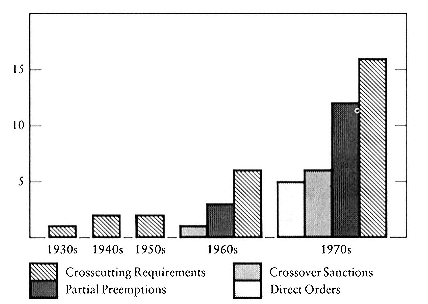
Figure 1.1
Federal Regulation of State-Local Governments, 1930–1979
Source: Advisory Commission on Intergovernment Relations (n.d.), p. 4.
state-local sector can be debated, there can be little doubt that these regulations have significantly influenced the policies and budgets of state and local governments.
We are now a federalized, federalist system. President Reagan's "new federalism" reforms strike at the heart of this centralization process. First, the two major income-maintenance programs now at the federal level—food stamps and AFDC—are to be returned to the state and local sectors. In 1983, these programs were estimated to cost the federal government $16.4 billion. A dollar shift of this magnitude will reduce the federal share of transfer to persons from 87.2 percent in 1983 (Table 1.1, column 8) to 83 percent.[4]
Second, the Medicaid program is to become fully a federal responsibility. On the surface, this adjustment appears to run counter to the defederalization intentions of the Reagan policy. The new federal Medicaid outlays, approximately $19 billion, will increase the federal share in transfers to persons, from 83 percent following the decentralization of welfare, back to 87 percent. Despite this upward adjustment in federal
spending, it can be argued that the offer to take on the state's share of Medicaid is a necessary component of the new federalism package. The states and their congressional representatives will not accept the income-maintenance programs without some form of budget relief to compensate for the additional expense of these programs. Direct grant relief might be more of the same—federally funded aid for federally mandated programs. Relief could, however, be offered in the form of a federal takeover of a state responsibility. But which state responsibility? The state share of the Medicaid program is an excellent choice for three reasons: (1) the state Medicaid outlay is large and growing and a bit more than the federal dollars now spent on food stamps and AFDC, i.e., it is a "fair" trade; (2) the states have been doing a very poor job of controlling Medicaid outlays; and (3) there is a growing desire at the federal level to control federal health care costs, and Medicaid, if federalized, can more easily be included within any new federal regulations. The states do not want the responsibility of Medicaid, and for reasons not entirely related to federalism, the Reagan administration is willing to take it on. From the point of view of the new federalism, the swap of the state share of Medicaid for income-maintenance programs seems the best available trade.
Third and finally, Reagan's new federalism proposes to return to the state-local sector sixty-one existing federal-education, social-service, transportation, and community-development categorical aid programs for state administration and funding. To ease the estimated $30.2 billion financial burden imposed by these new programs, the federal government would make available to the states $27.6 billion from a federal trust fund supported by federal excise taxes. (The states' shortfall between program costs and trust fund transfers equals the states' gain from the welfare/Medicaid swap.) The intention of this exchange is to reduce federal control over state and local spending; categorical aid and its particular expenditure restrictions are dropped and replaced with unconstrained federal assistance. This federal-trust-fund aid is to be phased out, however, over four years beginning in 1988. Thus, the third component of the new federalism is intended first to reduce federal aid restrictions and then, beginning in 1988, gradually to reduce federal government spending and taxes.[5] Overall, the new federalism is: (1) to leave the federal share of transfer outlays largely unaffected but to move to the federal level those redistribution expenditures (Medicaid) that the states have found the most difficult to control; (2) to replace federal categorical aid with lump-sum aid, thereby reducing federal control over state-local spending; and finally, (3) to reduce federal spending and taxes by gradually phasing out
the trust fund and its associated taxes. Or so the proponents of the new federalism hope. Whether the new federalism will in fact have these defederalizing effects is an open question.
Will the "New" Federalism Work?
While the calculations above concerning effects of President Reagan's new federalism on our fiscal system are reasonable first guesses, they are really only that—first guesses. Budget aggregates were simply moved from the federal to the state-local column and back again. Missing from such calculations is any sense that there are governments, and voters, who determine what those budget aggregates will be. Yet an analysis of such a fundamental realignment of fiscal responsibilities as the new federalism proposes must recognize that the state-local sector will react to the reforms. To predict the consequences of new federalism we must first understand the budgetary process of state and local governments.
State-Local Fiscal Choice in a Federalist Economy
Beginning with the early "determinants" studies of state and local spending, economists and political scientists have tried to untangle the causes of decentralized governments' fiscal choices. Analysis has proceeded from simple linear regression models of aggregate state and local spending to sophisticated maximum-likelihood estimation of utility maximization models for decisive voters in individual jurisdictions. But all these models have one element in common: they are economic models, with a central focus on citizen preferences and their budget constraints as causes of governmental expenditures.
Figure 1.2 illustrates the basic, and now familiar, story. A "typical" resident's preferences for public services and private goods are represented by a utility relationship over after-tax private income (y ) and public goods (g ), denoted U(y,g ). The indifference curves in Figure 1.2 rank the relative value of different combinations of y and g as represented by U(g,y ). Combinations of y and g on a higher indifference curve are preferred by the typical resident to those combinations on a lower indifference curve. A budget constraint will restrict the level of services which the typical resident can afford. The constraint is defined by the identity: Î=y +p·g , where Î is the typical resident's "full fiscal income" and p is the resident's "tax price" of local public goods. Full fiscal income is the sum of the resident's before state-local-tax private income (I) and the resident's
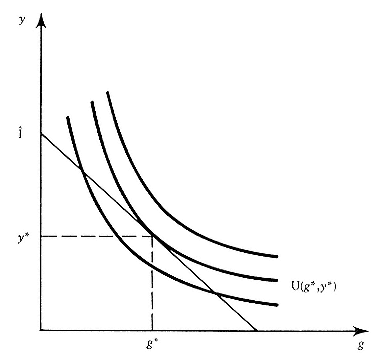
Figure 1.2
The "Typical" Voter's Preferred Budget
share of federal to state/local lump-sum aid per resident (z ). The tax price p equals the resident's share of the tax costs of each unit of the public service, net of federal matching aid.[6]
Given preferences and the budget constraint, the typical resident will wish to buy the level of public goods that maximizes U(y,g ) subject to the constraint. This is point (y*,g* ) in Figure 1.2, where the budget line is just tangent to the highest possible indifference curve. The utility maximization/budget constraint model yields a demand curve for local public goods of the following form:
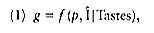
where the theory predicts that ¶ g/¶ p<0, ¶ g/¶ Î>0. The taste variables (Tastes) are unique to the individual resident.
Economists are now quite comfortable with this specification of state-local fiscal choice and have applied it on numerous occasions to estimate local governments' responsiveness to various federal-government aid and tax policies. (Inman 1979 reviews these studies.) One nagging question
has, however, been left unanswered by virtually every application of this approach. Who is the "typical" resident whose demand curve we are estimating? Answers have relied more on hand-waving than hard work. Empirical analyses of state-local fiscal choice have generally lacked any notion that politics, the process of conflict resolution, affects state-local fiscal allocations. Exactly whose preferences and whose budget constraints dictate the final allocations? Is the final allocation a compromise among several players, or just the preferred outcome of a "chosen" one? Who are these players? What is their standing and what are their rights within the political budgetary process? How are disagreements resolved? What happens if there is no agreement? These are political questions, and their answers require political analysis.
Introducing political considerations into the systematic analysis of budgetary choice is not a simple matter. Once we begin to study allocations involving more than one policy dimension—say, education and welfare spending—we confront a fundamental analytic difficulty. If there are more than two interested voters, such allocations will generally not have a stable equilibrium if budgets are decided by a simple majority-rule process, for there is no identifiable median voter in such cases (see Inman 1984). Yet state-local budgetary choices are often very stable; allocations do not change much from year to year. In an important line of new research, Shepsle (1979) has described and analyzed various legislative extensions of simple majority rule that are sufficient to produce stable fiscal allocations. The final allocations—called structure-induced equilibria —are conditioned by the status quo and the constitutional rules that determine legislative structures. Shepsle identifies three central structural features of legislatures: (1) a committee structure that identifies who is allowed to offer proposals for consideration by the full legislature; (2) a jurisdiction structure that defines which proposals may be considered by the committee and the legislature; and (3) an amendment structure that describes how the committee's proposals to the legislature may be altered. Together these structural features can insure a stable allocation. It is important to emphasize, however, and particularly for our purposes here, that a structure-induced equilibrium is a partial equilibrium, conditioned by the starting or status-quo allocation and the detailed rules of fiscal choice. Exogenous changes in the starting allocation or legislative rules because of new federal regulations or aid programs, such as the new federalism, will alter the observed equilibrium allocations.
The political theory of structure-induced equilibria allows us to specify just how such institutional changes will affect budgetary choices. The
theory predicts that final fiscal allocations will be a simple weighted average of the preferred allocations of each voter. The weights depend on the status quo (denoted as g°, a vector of initial service levels) and the political institutional structure (denoted S, a vector of institutional variables). The allocation for service t preferred by each voter or interest group i is defined by the demand curve git = f it (pi , Îi ¦Tastesi ), as specified in equation (1) above, where now pi is a vector of public-good tax prices. The resulting model of budgetary choice is therefore

where

and where there are t = 1 . . . m public services and i = 1 . . . n identifiable voter types or interest groups. Variables that might be included in the vector S of political structure include controlling interests (chairmanship, majority) of the legislative committees that set the agenda, jurisdiction and budgetary and bargaining rules on how dollars can be allocated, size of voting blocs within the legislature or community, political allegiance of those with veto power over final allocations (e.g., governor, mayor), and amendment rules that allow proposals to be submitted from at-large interests. The budgetary model outlined here—once it has been estimated—gives us exactly what we need to begin to analyze the effects of changes in federal dollars and fiscal structures on state-local allocations. Three recent studies (Craig and Inman 1982, Gramlich 1982, and Craig and Inman 1984) have examined President Reagan's new federalism from this perspective; their results are instructive as to the likely budgetary consequences of the proposed Reagan reforms.
The Medicaid-Welfare Swap:
What Will Happen to Low Income Assistance?
Gramlich (1982) and Craig and Inman (1984) have examined the likely consequences of the new federalism's proposed exchange of the food stamps and AFDC programs for Medicaid. Both studies reach essentially the same conclusion: the states will appreciably reduce their support of low income maintenance programs despite federal assumption of Medicaid and the availability of $27.6 billion in trust fund aid.
Employing an analytic framework similar to that proposed in Equation 2 above, Gramlich and Craig–Inman estimate the effects of the current
fiscal structure—categorical matching aid for AFDC and Medicaid, federal provision of food stamps, and the availability of general revenue-sharing and other (nearly) unrestricted, lump-sum aid—on the state decision to provide AFDC benefits (Gramlich) and AFDC plus other low-income assistance (Craig–Inman).[7] Both studies find that dropping federal, categorical matching aid for AFDC and giving states full financial responsibility for the program will reduce spending for AFDC by at least 70 percent and perhaps as much as 95 percent. Gramlich arrives at the larger estimate when he allows for the fact that states are likely to adjust their benefit levels to those of their neighboring, fiscally competitive states. Since high benefit levels are likely to attract low-income families (see Gramlich's paper in this volume) and possibly discourage the location of richer families and firms, no state can afford high benefit levels by itself. Once the federal categorical matching aid, a strong incentive for high benefits, is removed, interstate fiscal competition dominates the allocation process, and AFDC spending is likely to fall dramatically.
Both studies conclude that low-income support from the food stamp program will also be significantly reduced. They find that state officials seem to behave as if food stamp benefits do not exist; in other words, it is a federal program and provides no direct political benefit to state politicians. A program thus ignored in the past will probably be supported only marginally under reform. The net effect of the new federalism's food-stamp transfer will be to reduce this form of assistance drastically, if not totally. Together, the transfer of AFDC and food stamps to the states is estimated to reduce the total spending on these programs by 70 percent or more.
Federal assumption of state Medicaid payments may also reduce the states' contribution to low-income medical assistance. First, as the federal government takes over the program, the previous federal Medicaid matching grant to the states is lost (i.e., the matching rate falls to zero) and state spending for low-income medical assistance declines. Second, the federal government will pay such low-income medical assistance directly to residents within the state, a possible inducement for the states to eliminate any remaining low-income medical-assistance programs. Craig and Inman (1984) estimate that the combined effect of these forces about equals the current level of state expenditures on Medicaid; that is, state welfare spending will fall by the amount of spending assumed by the federal government when it takes over Medicaid (~$19 billion).
The new federalism does offer the states financial assistance, however, and some of this relief may spill over into low income assistance. The
proposed trust-fund account is to pay states $27.6 billion a year initially (less in future years). Craig and Inman estimate that trust fund aid will have no significant effect on low income assistance and may in fact depress welfare spending. Other studies (reviewed in Inman [1979]) also show no major positive effect of lump-sum aid on welfare outlays. It therefore seems safe to assume that trust fund assistance will do little to offset any decline in welfare spending.
What, then, will be the overall effect of the new federalism on state-provided low-income assistance? As we have seen, a conservative estimate is that AFDC and food stamp spending will fall by 70 percent when transferred to the state-local sector. In 1983, the federal and state governments combined spent approximately $24.04 billion on AFDC and food stamps.[8] The new federalism will reduce this total by $16.83 billion. With the Medicaid transfer, state expenditures on medical assistance for the poor will fall by approximately $19 billion, but federal spending is assumed to rise to fill this gap. There is therefore no net effect on low income assistance from the Medicaid transfer.[9] The introduction of $27.6 billion in trust fund assistance is estimated to have no effect on state welfare spending. The combined effect of the new federalism reform is therefore an estimated decline of at least $16.83 billion in aid to low-income families provided by all levels of government. From the perspective of a typical low-income family, the new federalism may mean a loss of $2406 annually, approximately a 44 percent decline in average annual benefits.[10] Clearly, the new federalism is an important fiscal reform affecting low-income households.
The Trust-Fund and Program Turnback:
What Will Happen to Service Provision?
The sixty-one federal categorical-aid programs proposed for transfer to the states include programs in education, social services, transportation, and community development. Also included is the general revenue-sharing program. In their place the federal government will establish a trust fund that will pay to the states a lump-sum grant approximately equal to the costs of transferred categorical-aid programs. This component of the new federalism essentially substitutes unconstrained aid for categorical aid. What will happen to the provision of government services in the affected program areas?
Gramlich's (1982) analysis gives an overview of the likely effects of fiscal reform. He finds that the loss of $1 of federal categorical aid will
lower state-local service expenditures by $0.38; the gain of $1 of federal lump-sum assistance will increase state-local service spending by $0.04. Gramlich's estimates of the state-local sector's response to lump-sum, revenue-sharing assistance is somewhat lower than that obtained by other researchers (see Inman 1979), but it should be pointed out that his sample covers the state-local experience to 1981 and therefore includes those governments' response to the recent pressure for fiscal responsibility and tax relief. Accepting Gramlich's estimates, we can calculate the aggregate effect of the new federalism on service provision. Turning sixty-one federal programs over to the states is equivalent to a loss of $25.6 billion in categorical aid and, since general revenue-sharing is included in the turnback program, a loss of $4.6 billion in lump-sum aid. The loss of $25.6 billion in categorical aid will reduce state-local service provision by $9.7 billion (=0.38 × $25.60). The loss of $4.6 billion in revenue-sharing aid will reduce state-local service provision by $0.2 billion (=0.04 × $4.60). The trust fund, on the other hand, increases federal lump-sum aid by $27.6 billion; the state-local sector's response is to increase state-local provision by $1.1 billion (=0.04 × $27.60). The final net effect of the new federalism is to reduce state-local spending initially by $8.8 billion. This loss is equivalent to a decline of $16 per capita in services (measured in 1972 dollars) or a fall in public-service provision by the state-local sector of 2.1 percent from the 1983 service level of $768.40 per capita (see Table 1.1, column 7).
Craig and Inman's (1984) analysis of the trust-fund exchange shows a similar, though slightly larger, decline in state-local spending. Their equilibrium analysis predicts that the trust fund–program swap will reduce state taxes by 6 percent (due to relaxed matching requirements), lower state education aid and total state welfare spending by 5 percent and 33 percent respectively, and leave other state spending virtually unchanged. The states' human resource budgets seem to bear the full brunt of the spending cuts. Local government spending may rise to offset some of the decline, but the local increase will probably not match the fall in state spending.
A more detailed look at state-local education spending shows that this is exactly what happens. Craig and Inman (1982) have examined the effects of Reagan's new federalism on spending for one of the most important program areas—elementary and secondary education. Their results are suggestive of what may happen to expenditures on the other directly affected services. After estimating an econometric model of state and local school spending, Craig and Inman simulate the effects of the
| ||||||||||||||||||||||||||||||
new federalism in which fourteen categorical education aid programs are consolidated into a single trust-fund, or lump-sum, grant to states. Table 1.5 summarizes their results, where spending in 1977 (the last year of their sample) defines the baseline, or pre-reform, allocation. In the status quo period, the average state allocated $375.58 per public-school enrollee for state aid for education. The average state raised $1,025.86 per enrollee in state taxes, where the difference between taxes and state education aid ($650.28 per enrollee) was allocated to other, non-education state expenditures. Local school districts spent $670.99 per enrollee on education, and raised $286.34 per enrollee in local taxes to support this spending. The remaining $386.65 per enrollee of local spending was financed by state education aid ($375.58) and direct federal-to-local school aid ($9.07 per enrollee). Following new federalism reforms, Craig–Inman estimate that state support for public elementary and secondary education will fall by about 23 percent, to $290.20.
The primary reason for this decline is the same that led to a decline in welfare spending: the new federalism substitutes less constraining lump-sum aid for categorical and categorical matching aid.[11] Left on their own, states do not want to maintain spending on public education. What happens to the money now freed from the state education budget by the new federalism? The released $85.38 per enrollee (=$375.58 – $290.20) is allocated to tax relief; total state tax relief is $101.44/enrollee (=$1,025.86 – $924.42) supported in part by a fall in other (administrative?) state expenses.[12] The fall in state-to-local education aid and federal-to-local education aid reduces local school spending by about 8 percent, or $616.35/enrollee. To maintain this level of spending, local taxes must rise by 14 percent, to $326.15/enrollee. The new spending level is supported entirely by local taxes and state aid (616.35 = $326.15 + $290.20). This detailed analysis of the new feder-
alism's effects on education reveals three important conclusions. First, education itself is not a particularly favored activity of state governments; it is federal categorical aid that keeps state funding at its present levels. Second, as the federal and state governments retreat from a fiscal responsibility for education, local school districts fill the void, somewhat; clearly, with the new federalism, financial responsibility for public education moves downward to the local level. Third, as President Reagan might have hoped, the new federalism will alter the mix of national income allocated between the private and public sectors. State taxation is lowered by $101/enrollee, while local school taxes rise by about $40/enrollee. The net result is a $61/enrollee increase in private income.
Summary
It is hoped by the proponents of the new federalism that the proposed reforms will reverse the trend toward federalization of our public economy and to a large degree shift the activity of government back to the state and local levels. The analysis summarized here suggests that they will not be disappointed. The very nature of the reform reallocates responsibilities from the federal to the state-local sector, and there is nothing in the empirical research reviewed here to suggest that reforms will not be decentralizing. The states, for example, have not been held in line by federal programs so that, now unleashed, they can spend unchecked to replace one bureaucracy with another. Quite the contrary, the evidence indicates that the states will retreat from many of these categorical program areas too and, at least in the case of education, will be eager to pass fiscal responsibility down still further, to the local level.
The empirical analyses of the new federalism reveal another important consequence of reform, one which might please President Reagan even more than the move to decentralization. The new federalism will likely shrink the size of government. The exchange of Medicaid for AFDC and food stamps will markedly reduce spending on income maintenance programs and return those released dollars to state taxpayers as tax relief. The new federalism's exchange of the lump-sum trust fund aid for categorical aid also means tax relief. Craig and Inman (1982) find that, in education at least, the resulting lower level of state education spending is transferred to taxpayers as state tax relief. Local education taxes do rise, but not by enough to offset the decline in state taxation. Again, the overall size of government is reduced and taxpayers' private incomes are increased.
From the point of view of those who wish to decentralize fiscal choice and to decrease the size of government, the answer must be yes to the question: Will the new federalism work?
New Federalism as a Federal Issue
If Reagan's new federalism will check the tide of fiscal centralization and shrink government, why then, in this era of apparent fiscal conservatism has the new federalism not been approved by the federal government? The early debates of the reform raised the obvious questions. There was much discussion about the accuracy of the administration's estimates of program costs, and the states were obviously disappointed about the projected 1988–1991 phase-out of the supporting trust fund. Would the dollar trade really be a fair one? But if a balancing of dollars was all that was at issue, we should have resolved the difference long ago. We have not. The matter runs deeper than that. The new federalism is not simply a realignment of programs between the federal and state-local sectors of government, it is a fundamental challenge to how public policy decisions are now made. Our existing, highly federalized fiscal structure did not just happen. It has evolved, I will argue, as a logical outcome of a changing federal political structure and a growing economic pressure on local governments to redistribute resources. Until the political structure changes again—and in a particular way—or until the demand for redistribution subsides, our fiscal structure will remain largely as it now stands: categorical, regulated, and centralized.
The pressure to use government as a means to redistribute resources among the members of the society is endemic to stable economies. Coalitions of potential beneficiaries form around existing, shared institutions capable of transferring dollars in their direction. Producer or consumer groups form about markets; the religious, the poor, and the ill cluster about churches; and all of us look to government for assistance. Small groups can generally organize more quickly and efficiently than large groups; while the fortunes of individual redistributive coalitions may rise or fall, such coalitions rarely die (see Olson 1982). American economic history is rich in examples of the growth and influence of redistributive coalitions (see, e.g., North 1981; Olson 1982).
With the baby boom and the explosion of home ownership and suburbanization following World War II, a new and fertile ground for the growth of such coalitions appeared—state and, most importantly, local governments. Table 1.1, column 6, illustrates the increasingly important
role of the state and local sector in the provision of domestic public goods and services. The growth was particularly explosive from 1945 to 1960 as the share of the state-local sector in public-good provision rose from 69.3 percent to 84.5 percent. During this same period the number of municipal, township, and special district governments grew from 43,440 in 1942 to 56,417 in 1967.[13] The period from 1945 to 1960 saw the emergence of new redistributive coalitions with their focii almost exclusively on local government. Public employee unionization began in earnest in this period. The National Teachers Association began its slow evolution from a social and professional society to a politically active union, prodded in part by the aggressive, blatantly redistibutive behavior of the newly formed American Federation of Teachers. In our larger cities, downtown business interests began to organize for the development, or redevelopment, of shopping, residential, and business centers. In the suburbs, developers lobbied for new infrastructure (paid for by tax-exempt bonds) and zoning variances. Even the large group of innercity poor had become organized into a politically active redistributive coalition, the National Welfare Rights Organization. Each of these coalitions—public employees, business groups, the poor—turned to local governments for more—more pay, more services, more transfers. Yet the local public sector had only limited resources, and it was severely constrained by the mobility of its tax base. It was only natural that, as the brokers in the redistribution game, local officials should seek more dollars. They organized too, and in the 1960s they went to Washington as the "intergovernmental" lobby.[14] Would Washington respond?
Washington did respond—with creative federalism. The redistributive coalitions collecting about the local public sector had created a new demand for transfers. The supply of those transfers came from a United States Congress that by the mid 1960s found it particularly attractive to be responsive. Domestic policies began to assume a decidedly regional and local focus. The fiscal structure we now call creative federalism, with its extensive use of categorical aid, project aid, and federal regulations, is one consequence of this change.
Two events converged to produce this important shift. First, American voters were becoming better educated and better informed. The old political party labels were no longer sufficient to insure voter loyalty. Nie, Verba, and Petocik (1979) found the 1960s voter to differ in important ways from the 1950s voter. There were more independents, and even those voters who wore a party label found it easy to desert the party leadership when proposed policies did not meet their demands. Second,
as voters became more independent so did their congressional representatives. For exogenous reasons the strong central leadership of Lyndon Johnson in the Senate and Sam Rayburn in the House gave way in the 1960s to the less autocratic styles of Mansfield and McCormack. The 1964 Democratic landslide brought a new and active group of Democratic liberals into the House, many representing urban local coalitions. The old, fabled "conservative coalition" of Republicans and southern Democrats gave way, lost in a flurry of liberal legislation—including Medicaid, federal grants for education, urban poverty programs, and the creation of the Department of Housing and Urban Development. Much of the legislation was a response of a sympathetic Congress to the memory of a president deeply committed to social legislation.
The period 1967–1970 was one of frustration for the Democratic liberals. A fall in their numbers from the peak in 1965–1966, division within their ranks over the war in Vietnam, the election of a Republican president, and the return to importance of the conservative coalition thwarted the efforts of liberal, urban Democrats to introduce further domestic legislation. These three years proved only a temporary setback in the trend toward a more open, more locally focused Congress. Beginning in 1970, a series of procedural reforms initiated by the liberals were enacted by the Democratic Caucus and by the whole House. The intention of the reforms was to open the key leadership positions of the House—committee and subcommittee chairmanships—to more members, not just the senior, select few (for an interesting description of the process by which these reforms were introduced, see Ornstein 1975). The result was a more diffuse, younger, liberal leadership. The incentives within this more decentralized structure no longer encouraged individual representatives to look to the older leadership for signals on how to form policy. Rather, the structure encouraged offering a favored policy and bargaining with other members for its approval. And how should a representative define a policy agenda? Again, not by turning to the central leadership or to the Democratic or the Republican party. Their approval no longer won local congressional elections. The representative's policy agenda came from the local voters, for if local voters were satisfied, reelection was guaranteed (see Fiorina 1977, esp. chs. 4 and 5). The policies and budgets that emerge from such a decentralized political body will themselves be decentralized in their effects, satisfying the needs of each representative and the redistributive coalitions he or she represents.[15] When representatives are chosen from geographically prescribed areas, policies will assume a clear regional or local focus. Creative feder-
alism stands as a telling example of what such a political process will produce.
A decentralized congressional policy process seeking to satisfy the demands of local redistributive coalitions will necessarily design policies that will target federal dollars to local areas. Further, these dollars must be targeted to particular redistributive coalitions in a way that will assure that the congressional representative can claim credit for the transfer. Finally, if the federal dollars can be leveraged from other, non-local revenue sources such as the state, so much the better. What type of federal grants policy will achieve these objectives? The answer is categorical project aid and formula aid that uses the states whenever possible as the administrative agent but that monitors state performance closely with "pass-through" and, ideally, matching requirements. To the extent that local redistributive coalitions do not trust the states to administer the grant in their favor, the federal program will bypass the states and give dollars to local governments, or perhaps to private groups directly. Finally, since there are many congressional districts to be satisfied and each district has a different set of local redistributive coalitions, a wide range of federal grants programs are needed, with, ideally, each program capable of allocating dollars to specific local coalitions.
Not surprisingly, exactly this grants system, which we now call creative federalism, emerged over the decade 1963–1973. Table 1.4 shows the proliferation of project-aid and categorical-formula grants. Project-aid programs, the most flexible form of grant and the most susceptible to congressional direction, nearly tripled in number from 1962 to 1976 (Chernick 1979, Arnold 1981, and Plott 1968 present interesting studies of possible congressional control of project aid). The number of categorical formula grants more than doubled during this period; many of these grants employ state "pass-through" requirements and almost all have a state matching provision of some kind.[16] Further, when the states could not be trusted to target federal aid to local coalitions, direct federal-to-local programs were devised; see Table 1.3. By 1973, direct federal-to-local aid had become nearly 20 percent of all federal categorical assistance. Most of this assistance was for urban areas, bypassing state governments presumably to avoid their rural-suburban bias (see Maxwell and Aronson 1977, tables 3.1, 3.2). Finally, as the analysis predicts, almost all local governments in the country received some categorical aid. A national survey of local governments in 1974 by the Advisory Commission on Intergovernmental Relations (1978) indicated that 73.3 percent of the responding city governments received federal categorical aid, and
80.6 percent of the responding county governments received such assistance. The typical city in the survey obtained money from an average of 9.3 grants; the typical county obtained money from an average of 20.6 grants. By the mid 1970s, we had in place a federalist fiscal structure which stood as the logical outcome of the economics and politics of its time.
One anomaly in the recent history seems to run against this logic—General Revenue Sharing (GRS0. In fact, however, close examination of the GRS history reveals that it was shaped by the same economic pressures and the same political structure that has given us creative federalism. When all the political maneuvering was done, the bill approved in June 1972 looked very little like the first Nixon proposal presented in August 1969. The initial Nixon plan gave 73 percent of the money to states, and those states that paid more federal taxes got more federal GRS aid. The GRS bill that was passed gave most of the aid to local governments (66 percent), aid given to the states contained an implicit match on state taxes, and the final distribution of money across local governments was effectively on the basis of population—i.e., equal funds per capita (see Nathan, Manuel, and Calkin 1975). Lastly, GRS was all new money for local governments; it did not replace any existing categorical aid programs. In effect, the political history of GRS proves to be just another chapter in our story.[17]
President Reagan's new federalism seeks to put an end to this tale called creative federalism. Will he succeed? The answer, I think, is no . The economic pressures and the political structure that produced creative federalism are still in force. The new federalism is too fundamental a change to be embraced by those who now benefit from our present fiscal structure.
Members of the House, for example, now have a wide range of categorical aid programs which direct federal resources to their favored local coalitions. As Representative John Brademas, the author of a number of categorical aid programs, commented concerning the local activities financed by general revenue sharing, "They don't even ask us to the ribbon-cutting ceremonies" (quoted in Beer 1976, p. 185). It is difficult for a member of Congress to claim credit for tax relief and general trust-fund grants—unlike classrooms, roadways, sewers, or jobs—when running for reelection. Congress prefers particularized programs (see, e.g., Mayhew 1974, pp. 53–57).
State and local officials have also shied away from Reagan's new federalism. The states, of course, were eager to give up Medicaid since it meant
freed dollars, but they did not want to take on AFDC and food stamps in return. And for good reasons. State and local officials prefer redistribution to be handled at the federal level. Only in those few states with no significant low-income population will state officials prefer a decentralized welfare system. Those states can neutralize any political pressure from their small low-income group while receiving the spill-in benefits of being a low-transfer, low-tax state. Elected officials in all other states, however, will feel the pressure of having to do something for the poor at the same time that they try to control taxes on firms and mobile upper-income households. The current federal categorical welfare programs make these hard decisions for them and apply them uniformly across all the states. State officials want more lump-sum aid, but not at the price of fewer welfare aid programs and greater interstate competition (see Rose-Ackerman 1981). Local officials fear the loss of regulated, categorical aid, for the simple reason that they see less money coming their way. As Craig—Inman (1982) show for education aid, when the federal strings are loosened, the level of state-to-local support can fall significantly (see the comments of state and local officials in National Journal 1982).
Finally, voters have not risen to demand reform, and there are two good reasons for this. First, many voters are direct beneficiaries of categorical aid; people do not want to lose the flow of dollars to their redistributive coalition. Some voters, however, do not benefit directly from the present federalized fiscal system. They pay taxes but get no return transfers. Craig—Inman (1982) have shown that the new federalism may mean significant tax relief. Why, then, have taxpayers not formed a coalition in support of the new federalism? The answer is simply that low-spending, tax-relief coalitions are hard to put together. We all benefit a little from the hard work of a few. Yet almost no one—elected local representatives or private citizens—can afford to be one of the hardworking few for tax relief. What is required is a national coalition held together by a commitment to the coalition's central objective, even when it is in everyone's best interest to "free-ride" on the group. Such coalitions may occur once in a while—the FY1982 budget and tax cut is an example—but not often.[18]
It is not surprising, then, that the new federalism has not yet won congressional approval. Our current fiscal system is what it is because of political and economic forces which will not be easily reversed. Whether a new economic coalition of taxpayers arises and proves that it can compete effectively within a special-interest political system as another special interest remains to be seen. To date, the proponents of the new federalism have not yet succeeded in fashioning such a coalition.
Conclusion
A federalist fiscal structure is an ever-evolving institution, responding, as will all societal institutions, to changing economic and political pressures. Our present structure, creative federalism, is the logical consequence of a rising pressure on local governments to respond to new local coalitions, and of a congressional political system that rewards those who are most responsive to these local demands. The resulting fiscal system channels federal funds to local governments and organizations via many narrowly prescribed categorical grants closely monitored by Washington. While such a fiscal system can be rationalized historically, there are good reasons to doubt its economic logic. Too much money is being spent on too many marginally inefficient programs.[19] A cutback and a restructuring of our aid program seem in order. Reagan's new federalism is one such proposal and, as we have seen, it is likely to have its intended effects of decentralizing fiscal choice and shrinking the size of government. Gramlich (this volume) has offered a plausible alternative reform package.[20] Neither reform, however, is likely to win congressional approval in the near future, for the simple reason that what is now in place is Congress's preferred response to our present economic and political environment. Only a substantial change in that environment will lead to substantial change in our fiscal structure.
Acknowledgments
This paper was written while the author was a visiting professor of economics at the University of California, Berkeley. It was financed in part by NSF grant SES-8112001 to the author and by a grant from the Center for Real Estate and Urban Economics, University of California, Berkeley. The financial support of these organizations is appreciated. Ken Shepsle, Art Frank, Dan Rubinfeld, and John Quigley were kind enough to read and comment on an earlier version of this paper, for which I am grateful.
References
Advisory Commission on Intergovernmental Relations. 1978. Categorical Grants: Their Role and Design. No. A-52. Washington, D.C.: U.S. Government Printing Office.
———. 1980. Recent Trends in Federal and State Aid to Local Governments. No. M-118. Washington, D.C.: U.S. Government Printing Office.
———. 1981. The Conditions of Contemporary Federalism: Conflicting Theories and Collapsing Constraints. No. A-78. Washington, D.C.: U.S. Government Printing Office.
———. N.d. Regulatory Federalism: Policy, Process, Impact and Reform. No. B-7. Washington, D.C.
Arnold, D. 1981. "The Local Roots of Domestic Policy." Pp. 250-87 in T.E. Mann and N. J. Ornstein, eds., The New Congress. Washington, D.C.: American Enterprise Institute.
Beer, S. 1976. "The Adoption of General Revenue Sharing: A Case Study in Public Sector Politics." Public Policy 24:127-96.
Bowen, H. 1943. "The Interpretation of Voting in the Allocation of Economic Resources." Quarterly Journal of Economics 58: 27-48.
Break, G. 1980. Financing Government in a Federal System. Washington, D.C.: Brookings Institution.
Bureau of the Census. 1975. Historical Statistics of the United States, Colonial Times to 1970. Washington, D.C.: U.S. Government Printing Office.
———. 1983. Statistical Abstract of the United States, 1983. Washington, D.C.: U.S. Government Printing Office.
Bureau of Economic Analysis. 1981. National Income and Product Accounts, 1929-1976. Washington, D.C.: U.S. Government Printing Office.
———. 1984. Survey of Current Business. Vol. 64. Washington, D.C.: U.S. Government Printing Office.
Chernick, H. 1979. "An Economic Model of the Distribution of Project Grants." Pp. 81-103 in P. Mieszkowski and W. Oakland, eds., Fiscal Federalism and Grants-in-Aid. Washington, D.C.: Urban Institute.
———. 1982. "Block Grants for the Needy: The Case of AFDC." Journal of Policy Analysis and Management 1: 209-222.
Council of Economic Advisors. 1984. Economic Report of the President, February, 1984. Washington, D.C.: U.S. Government Printing Office.
Craig, S., and R. P. Inman. 1982. "Federal Aid and Public Education: An Empirical Look at the New Fiscal Federalism." Review of Economics and Statistics 64: 541-52.
———. Forthcoming. "Education, Welfare, and the New Federalism: State Budgeting in a Federalist Public Economy." In H. Rosen, ed., Studies in State and Local Public Finance. Chicago: Chicago University Press.
Filimon, R., T. Romer, and H. Rosenthal. 1982. "Asymmetric Information and Agenda Control: The Basis of Monopoly Power in Public Spending." Journal of Public Economics 17: 51-70.
Fiorina, M. 1977. Congress: Keystone of the Washington Establishment. New Haven: Yale University Press.
Fiorina, M., and R. Noll. 1978. "Voters, Bureaucrats and Legislators: A Rational Choice Perspective on the Growth of Bureaucracy." Journal of Public Economics 9: 239-54.
Gomez-Ibañez, J. A. 1984. "The Federal Role in Urban Transportation." This volume.
Gramlich, E. 1969. "The Effects of Federal Grants on State and Local Expenditures: A Review of the Econometric Literature." Pp. 569-83 in Proceedings of the 62nd Annual Conference on Taxation. Lexington, Ky.: National Tax Association.
———. 1982. "An Econometric Examination of the New Federalism." Pp. 327-60 in Brookings Papers on Economic Activity .
Hamilton, B. 1983. "The Flypaper Effect and Other Anomalies." Journal of Public Economics 22: 347-62.
Inman, R. P. 1978. "Optional Fiscal Reform of Metropolitan Schools: Some Simulation Results." American Economic Review 68: 107-122.
———. 1979. "Fiscal Performances of Local Governments." Pp. 270-321 in P. Mieszkowski and M. Straszheim, eds., Current Issues in Urban Economics . Baltimore: Johns Hopkins University Press.
———. 1981. "Wages, Pensions, and Employment in the Local Public Sector." Pp. 11-57 in P. Mieszkowski and G. Peterson, eds., Public Sector Labor Markets: COUPE Papers on Public Economics , Vol. 4.
———. Forthcoming. "Markets, Governments and the 'New' Political Economy." In A. Auerbach and M. S. Feldstein, eds., Handbook of Public Economics , Vol. 2. Amsterdam: North-Holland.
Jackman, R., and J. Papdachi. 1981. "Local Authority Education Expenditure in England and Wales." Pp. 47-62 in M. J. Bowman, ed., Collective Choice in Education . The Hague: Martinus Nijhoff.
McGuire, M. 1978. "A Method for Estimating the Effect of a Subsidy on the Receiver's Resource Constraint." Journal of Public Economics 10: 25-44.
Maxwell, J., and J. R. Aronson. 1977. Financing State and Local Governments. Washington, D.C.: Brookings Institution.
Mayhew, David. 1974. Congress: The Electoral Connection. New Haven: Yale University Press.
Moffitt, R. 1984. "The Effects of Grants-in-Aid on State and Local Expenditures: The Case of AFDC." Journal of Public Economics 23: 279-306.
Nathan, R., A. D. Manuel, and S. E. Calkin. 1975. Monitoring Revenue Sharing. Washington, D.C.: Brookings Institution.
National Journal. 1982. "The New Federalism." Vol. 14, 27 February 1982.
Nie, N., S. Verba, and J. Petrocik. 1979. The Changing American Voter. Cambridge, Mass.: Harvard University Press.
Niskanen, W. 1975. "Bureaucrats and Politicians." Journal of Law and Economics 18: 617-43.
North, Douglass. 1981. Structure and Change in Economic History. New York: W. W. Norton.
Olson, M. 1982. The Rise and Decline of Nations. New Haven: Yale University Press.
Ornstein, N. J. 1975. "Causes and Consequences of Congressional Change: Subcommittee Reforms in the House of Representatives, 1970-73." Pp. 88-114 in N. J. Ornstein, ed., Congress in Change . New York: Praeger.
Plott, C. 1968. "Some Organizational Influences on Urban Renewal Decisions." American Economic Review 58: 306-321.
Pommerehne, W. W. 1978. "Institutional Approaches to Public Expenditures: Empirical Evidence from Swiss Municipalities." Journal of Public Economics 9: 255-80.
Romer, T., and H. Rosenthal. 1979. "Bureaucrats vs. Voters: On the Political Economy of Resource Allocation by Direct Democracy." Quarterly Journal of Economics 93: 562-87.
Rose-Ackerman, S. 1981. "Does Federalism Matter? Political Choice in a Federal Republic." Journal of Political Economy 89: 152-65.
Russell, L. 1983. "Medical Care." Pp. 111-14 in J. Pechman, ed., Setting National Priorities: 1984 Budget . Washington, D.C.: Brookings Institution.
Scheiber, H. N. 1966. "The Condition of American Federalism: An Historian's View." Subcommittee on Intergovernmental Relations to the Committee on Government Operations, U.S. Senate, 15 October.
Shepsle, K. 1979. "Institutional Arrangements and Equilibrium in Multidimensional Voting Models." American Journal of Political Science 23: 27-59.
Shepsle, K., and B. R. Weingast. 1981. "Political Preferences for the Pork Barrel: A Generalization." American Journal of Political Science 25: 96-111.
Stockman, D. 1975. "The Social Pork Barrel." The Public Interest no. 39: 3-30.
Weingast, B., K. Shepsle, and C. Johnsen. 1981. "The Political Economy of Benefits and Costs: A Neoclassical Approach to Distributive Politics." Journal of Political Economy 89: 642-64.