
The Age-Sex Structure in 1841 and 1851
Age pyramids have been constructed for the sample districts of Shortwood, Newmarket, Forest Green, and Winsoredge. These were the most important of the Vale hamlets, since they contained a much higher proportion of the industrial population than did Nailsworth village, however less urbanized they remained. The age pyramids appear as figures 15 and 16 with accompanying tables 37 and 38, respectively. Table 39 summarizes the pyramid structures by age groups only and presents the results of difference-of-proportions tests, designed to measure the extent of change during the decade.
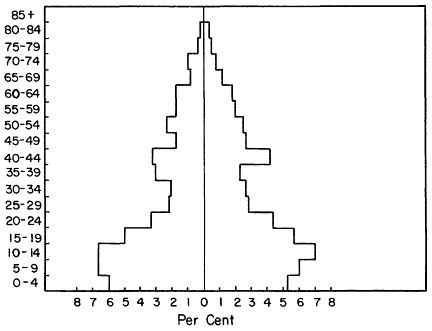
Fig. 15.
Age pyramid of four Horsley-Nailsworth hamlets, ca. 1841.
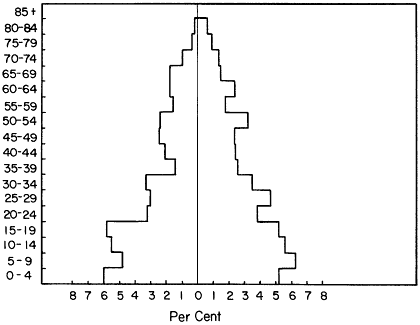
Fig. 16.
Age pyramid of four Horsley-Nailsworth hamlets, ca. 1851.
The pyramids depict unevenly distributed population loss. Net loss for the entire sample was 3.2 percent, just below the 6.6 percent figure for Horsley-Nailsworth.[68] The sex ratio continued to favor women, although not as much as in 1841. Table 37 shows that very few age cohorts experienced change. Among the very young, ages zero to nineteen, only those in cohort ten to fourteen fell significantly as a proportion of the population. At the opposite end of the pyramid, among the aged, only cohort sixty-five to sixty-nine increased significantly. The middle cohorts, ages forty-five to sixty-four, hardly changed, but among young adults, ages twenty-five to thirty-four, and the early-middle-age cohorts, thirty-five to thirty-nine and forty to forty-four, the changes were startling. The proportion of young adults increased significantly, while the proportion of the early-middle-age cohorts declined correspondingly. The negative impact of outmigration therefore registered in the early-middle-age cohorts, in a fall in the proportion
TABLE 37. | ||||||
Males | Females | Total | ||||
Age group | N | % | N | % | N | % |
0-4 | 78 | 5.95 | 70 | 5.34 | 148 | 11.29 |
5-9 | 86 | 6.56 | 79 | 6.03 | 165 | 12.59 |
10-14 | 86 | 6.56 | 93 | 7.09 | 179 | 13.66 |
15-19 | 65 | 4.96 | 75 | 5.74 | 140 | 10.68 |
20-24 | 43 | 3.28 | 57 | 4.35 | 100 | 7.63 |
25-29 | 29 | 2.21 | 38 | 2.90 | 67 | 5.11 |
30-34 | 27 | 2.06 | 36 | 2.74 | 63 | 4.80 |
35-39 | 39 | 2.97 | 30 | 2.29 | 69 | 5.26 |
40-44 | 42 | 3.20 | 55 | 4.19 | 97 | 7.40 |
45-49 | 22 | 1.68 | 35 | 2.67 | 57 | 4.35 |
50-54 | 30 | 2.29 | 33 | 2.51 | 63 | 4.80 |
55-59 | 22 | 1.68 | 27 | 2.06 | 49 | 3.74 |
60-64 | 22 | 1.68 | 23 | 1.75 | 45 | 3.43 |
65-69 | 11 | 0.83 | 16 | 1.22 | 27 | 2.06 |
70-74 | 12 | 0.91 | 10 | 0.75 | 22 | 1.68 |
75-79 | 4 | 0.30 | 7 | 0.53 | 11 | 0.83 |
80-84 | 3 | 0.22 | 5 | 0.38 | 8 | 0.60 |
Totals | 621 | 47.34 | 689 | 52.53 | 1,310 | 99.90 |
Note : The hamlets analyzed include Newmarket, Shortwood, Forest Green, and Winsoredge. The overall sex ratio is 1,109 women per 1,000 males. | ||||||
of the very young, and, equally, in a rise in the proportion of the aged. The apparent stability of most of the cohorts, however, together with an increase in the proportion of young adults, seems to have offset the tendency toward decline. The issue to be addressed is whether the trend toward decline was more or less important than the trend toward improvement.
This question can be answered by grouping the frequencies of the changing age cohorts into the variables "decline" and "improvement" and testing their differences in a contingency table against the years 1841 and 1851 (see table 40). Although the variable "decline" continued to show significantly higher frequencies than did the variable "improvement," the former fell in number while the latter increased. Chi-square analysis reveals the overall differences to have been significant, and the weight of each cell
TABLE 38. | ||||||
Males | Females | Total | ||||
Age group | N | % | N | % | N | % |
0-4 | 76 | 5.99 | 66 | 5.20 | 142 | 11.19 |
5-9 | 61 | 4.81 | 80 | 6.30 | 141 | 11.11 |
10-14 | 70 | 5.52 | 71 | 5.59 | 141 | 11.11 |
15-19 | 74 | 5.83 | 66 | 5.20 | 140 | 11.04 |
20-24 | 40 | 3.15 | 48 | 3.78 | 88 | 6.94 |
25-29 | 38 | 2.99 | 60 | 4.73 | 98 | 7.72 |
30-34 | 42 | 3.31 | 45 | 3.54 | 87 | 6.86 |
35-39 | 18 | 1.41 | 30 | 2.36 | 48 | 3.78 |
40-44 | 27 | 2.12 | 32 | 2.52 | 59 | 4.65 |
45-49 | 31 | 2.44 | 31 | 2.44 | 31 | 2.44 |
50-54 | 30 | 2.36 | 40 | 3.15 | 70 | 5.52 |
55-59 | 20 | 1.57 | 23 | 1.81 | 43 | 3.39 |
60-64 | 21 | 1.65 | 19 | 1.49 | 40 | 3.15 |
65-69 | 21 | 1.65 | 19 | 1.49 | 40 | 3.15 |
70-74 | 12 | 0.94 | 18 | 1.41 | 30 | 2.36 |
75-79 | 4 | 0.31 | 12 | 0.94 | 16 | 1.26 |
80-84 | 3 | 0.23 | 8 | 0.63 | 11 | 0.86 |
Totals | 588 | 46.28 | 680 | 53.63 | 1,268 | 99.9 |
Note : The overall sex ratio for the same hamlets treated in table 37 is 1,156 women per 1,000 men. | ||||||
frequency shows the improvement variable in 1851 to have made the greatest contribution.
On balance, the trend toward improvement offset the trend toward decline, despite the overall net loss of population. Indeed, the residual population in 1851 may have been even more robust. The depressions of 1842 and 1848/49 forced out many of the early-middle-age cohorts with their families; however, the stabilization of the factory system during this decade, combined with the otherwise prosperous character of the period, permitted a significant rise in the number of young adults, while most other cohorts remained stable. In general, these findings affirm the impression of population loss through outmigration from the mid-1830s, but they also suggest that contemporary complaints about the consequences of such movement, while prophetic, were still
TABLE 39. | ||||||
1841 | 1851 | |||||
Age groups | Freq . | Prop . | Freq . | Prop . | Z-score | Pa |
0-4 | 148 | 0.112 | 142 | 0.111 | 0.00 | 0.5 |
5-9 | 165 | 0.125 | 141 | 0.111 | 1.10 | 0.14 |
10-14 | 179 | 0.136 | 141 | 0.111 | 1.93 | 0.03b |
15-19 | 140 | 0.106 | 140 | 0.110 | -0.32 | 0.37 |
20-24 | 100 | 0.076 | 88 | 0.069 | 0.01 | 0.49 |
25-29 | 67 | 0.051 | 98 | 0.077 | -2.70 | 0.00b |
30-34 | 63 | 0.048 | 87 | 0.068 | -2.71 | 0.00b |
35-39 | 69 | 0.052 | 48 | 0.037 | 1.85 | 0.03b |
40-44 | 97 | 0.074 | 59 | 0.046 | 2.98 | 0.00b |
45-49 | 57 | 0.043 | 62 | 0.048 | -0.60 | 0.27 |
50-54 | 63 | 0.048 | 70 | 0.055 | -0.80 | 0.21 |
55-59 | 49 | 0.037 | 43 | 0.033 | 0.55 | 0.29 |
60-64 | 45 | 0.034 | 52 | 0.041 | -0.93 | 0.18 |
65-69 | 27 | 0.020 | 40 | 0.031 | -1.77 | 0.04b |
70-74 | 22 | 0.016 | 30 | 0.023 | -1.28 | 0.10 |
75-79 | 11 | 0.008 | 16 | 0.012 | -1.02 | 0.15 |
80-84 | 8 | 0.006 | 11 | 0.008 | -0.06 | 0.27 |
N1 = 1,310 | N2 = 1,268 | % change = -3.2 | ||||
a Significance levels of 0.05 or less were regarded as the appropriate probability levels, at which differences between frequencies could be considered significant. A 0.05 significance level means that there is a 95 percent probability that the difference is significant. | ||||||
b The difference between proportions was significant. For a discussion of difference-of-proportions tests, see Blalock, Social Statistics , pp. 229-230. | ||||||
TABLE 40. | |||||||
1841 | eva | w | 1851 | ev | w | Total | |
Improvement | 130 | (162) | (6.2) | 185 | (153) | (6.8) | 315 |
Decline | 372 | (339) | (3.0) | 288 | (320) | (3.2) | 660 |
502 | 473 | 975 | |||||
Note: x2 = 19.445; df = 1, x 2> 3.841 at the 0.05 significance level; ev = expected value under the null hypothesis; w = weight or contribution of each cell frequency to chi-square. | |||||||
premature in 1851. Population loss was sufficiently significant, however, to have aborted the area's development into a large urban manufacturing center, despite its industrialization and passage through the demographic revolution.